
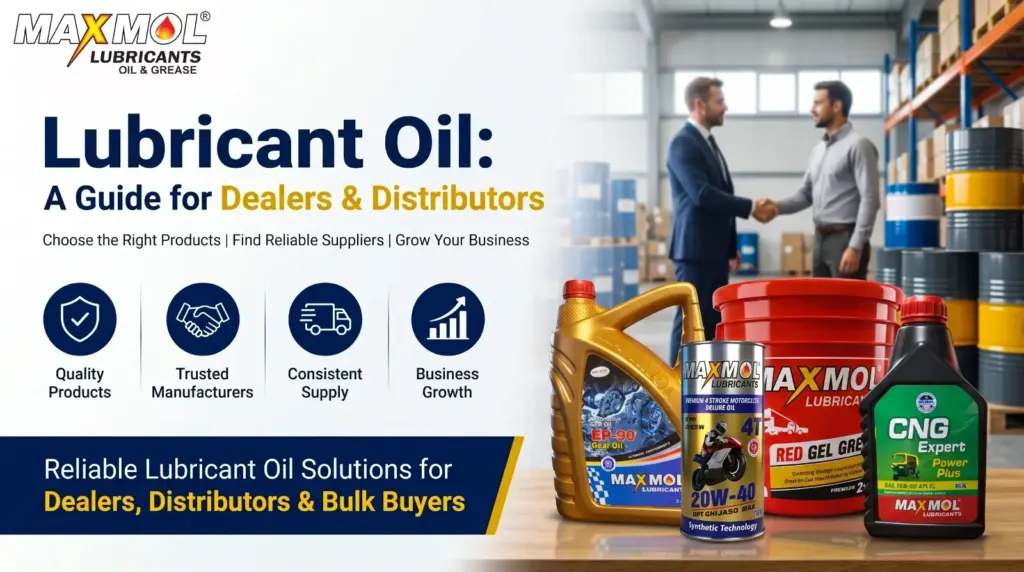
Lubricant Oil: A Guide for Dealers and Distributors in India
The demand for lubricant oil creates business opportunities for dealers, distributors, retailers, workshops, and bulk buyers across India. From motorcycle engine oil and car engine oil to gear oil and automotive grease, lubricants are essential for the maintenance and performance of vehicles and machinery.
For businesses planning to enter the lubricant market or expand their existing product range, choosing the right lubricant manufacturer and building a reliable supply network are important steps. Product quality, consistent availability, competitive pricing, and dependable business support can all influence long-term success.
In this guide, we explain how dealers and distributors can choose lubricant products, evaluate suppliers, and develop a lubricant business.
What Is Lubricant Oil?
Lubricant oil is a fluid used to reduce friction between moving parts, help manage heat, and protect components against wear. Depending on its formulation and application, a lubricant can also help control deposits, protect against corrosion, and support equipment performance.
Different applications require different lubricant formulations. For example, motorcycle engines, passenger cars, commercial vehicles, and industrial equipment may require different oil grades and specifications.
Common lubricant products include:
- Bike engine oil: Designed for compatible motorcycle engines and their lubrication requirements.
- Car engine oil: Available in different grades and specifications for passenger vehicles.
- Diesel engine oil: Formulated for compatible diesel engines, including many commercial vehicle applications.
- Gear oil: Used in compatible gearboxes and transmission systems.
- Automotive grease: Used to lubricate suitable bearings, joints, chassis components, and other specified parts.
- Specialty lubricants: Products developed for particular equipment or operating requirements.
Dealers should understand the applications and specifications of each product before recommending it to customers.
Why Is Lubricant Oil a Business Opportunity for Dealers?
Lubricants are used across vehicle maintenance, transport, repair, and industrial applications. This gives dealers several potential customer segments to serve, depending on their location, investment capacity, and distribution network.
1. Multiple Customer Segments
A lubricant dealer may supply products to motorcycle repair shops, car workshops, spare-parts retailers, garages, fleet operators, and other local businesses. Distributors can build a wider network by supplying smaller dealers and retailers across their assigned markets.
2. A Range of Products to Sell
Offering suitable engine oils, gear oils, and grease products can help dealers serve different customer requirements. A carefully selected product range may also create opportunities to develop relationships with repeat buyers.
3. Opportunities to Build Repeat Business
Workshops, retailers, and fleet-related businesses may need regular lubricant supplies. Reliable service, suitable product recommendations, transparent pricing, and timely order fulfilment can help build lasting business relationships.
4. Potential for Market Expansion
Dealers can start by serving customers in a local area and expand gradually as demand, working capital, and distribution capacity grow. Distributors may develop additional dealer relationships where supply arrangements and market conditions allow.
However, business results depend on local competition, customer demand, pricing, credit management, and effective inventory planning.
How to Choose the Right Lubricant Manufacturer
Selecting a reliable lubricant manufacturer is an important decision for dealers and distributors. The right supplier should offer products suited to your target market and provide clear information to support purchasing and resale.
Consider these factors before placing an order.
Product Range and Specifications
Check whether the manufacturer offers the lubricant categories your customers need. Review viscosity grades, applicable performance specifications, product applications, packaging sizes, and technical documentation.
Never recommend an oil solely because its viscosity grade matches another product. Always check the vehicle or equipment manufacturer’s requirements.
Product Quality and Documentation
Ask for relevant product technical data sheets, specifications, and applicable quality documentation. Verify performance claims and approvals where required, and ensure products are suitable for their intended applications.
Pricing and Order Requirements
Compare quotations based on the same product grade, pack size, quantity, applicable taxes, freight, and payment terms. A low purchase price does not automatically mean better profitability.
Supply Consistency
Ask about stock availability, dispatch timelines, minimum order quantities, and the process for handling shortages or damaged goods. Reliable replenishment helps dealers plan inventory and serve customers efficiently.
Dealer and Distributor Support
Discuss product information, sales materials, enquiry handling, territory arrangements, and any available promotional support. Confirm all commercial terms in writing before committing to a dealership or distribution arrangement.
How to Find Reliable Lubricant Oil Suppliers in India
When searching for lubricant oil suppliers, dealers should evaluate more than the advertised price. A supplier’s product range, business credentials, supply arrangements, and responsiveness can affect daily operations.
Use the following steps:
- Identify your target market. Decide whether you will focus on bike workshops, car garages, commercial vehicle operators, retailers, or industrial customers.
- Prepare a product list. Identify the engine oil grades, gear oils, grease products, and packaging sizes that match local demand.
- Compare suppliers. Request quotations and compare equivalent products, minimum order quantities, delivery costs, and payment terms.
- Verify product information. Check labels, batch details, technical documents, and the supplier’s business credentials.
- Understand the distribution terms. Ask about dealership eligibility, territory coverage, order frequency, returns, and any applicable targets.
- Begin with planned inventory. Estimate likely sales before committing too much working capital to slow-moving products.
- Maintain regular communication. Keep track of stock, customer feedback, and upcoming orders to improve replenishment planning.
A supplier should be able to explain its products and commercial terms clearly. Avoid relying on unverified claims about guaranteed profits, exclusive territories, or assured sales.
Lubricant Company in India: What Should Dealers Look For?
A lubricant company in India may serve different markets through its product portfolio, dealer network, distributors, and direct business relationships. The most suitable company for your business depends on your customers and the type of distribution arrangement you want.
Before selecting a company, consider:
- Whether its products match the requirements of your target customers.
- Whether the product range includes the grades and pack sizes you expect to sell.
- Whether pricing and margins are commercially workable after expenses.
- Whether the company explains its order, payment, and delivery policies.
- Whether technical and product information is available.
- Whether the company can support your expected purchasing volume.
- Whether the proposed dealership or distribution terms are clearly documented.
Dealers should assess the complete business arrangement rather than choosing a company on brand name or price alone.
Lubricant Distributor vs. Lubricant Dealer: What Is the Difference?
Although the terms are sometimes used interchangeably, a lubricant distributor and a lubricant dealer may operate at different levels of the supply chain.
| Factor | Lubricant distributor | Lubricant dealer |
|---|---|---|
| Main role | Supplies products to dealers, retailers, or other business customers | Sells products to local retailers, workshops, or end customers |
| Typical coverage | May serve multiple locations or a defined territory | Often focuses on a local market |
| Inventory | May manage larger stock volumes | Usually manages stock based on local demand |
| Customer relationships | Builds and maintains a network of business buyers | Develops relationships with workshops and local customers |
| Key considerations | Supply planning, working capital, logistics, and network development | Product selection, local sales, stock rotation, and customer service |
These roles are not fixed across every company. Actual responsibilities depend on the manufacturer’s or supplier’s distribution policy.
How to Start a Lubricant Oil Dealership
Starting a lubricant dealership requires market research, supplier selection, investment planning, and customer development.
Step 1: Research Local Demand
Visit workshops, garages, spare-parts shops, and other potential business customers. Understand which products they purchase, which pack sizes they prefer, and how frequently they reorder.
Step 2: Select Your Product Mix
Start with products that match verified customer requirements. Avoid purchasing a large quantity of every available grade before understanding local demand.
Step 3: Calculate Your Working Capital
Include inventory, transportation, storage, rent, staff expenses, taxes, credit sales, and other operating costs in your budget. Maintain a cash reserve for replenishment and unexpected expenses.
Step 4: Contact a Manufacturer or Supplier
Ask about dealership eligibility, opening order requirements, product documentation, payment terms, delivery schedules, and available business support.
Step 5: Develop a Customer Network
Build relationships with mechanics, workshops, retailers, garages, and other relevant customers. Explain product applications accurately and provide quotations that clearly state pack sizes and commercial terms.
Step 6: Monitor Sales and Replenishment
Track sales by product grade, customer, and pack size. Review slow-moving stock, outstanding payments, and reorder requirements regularly.
A planned approach helps you make purchasing decisions based on real demand instead of assumptions.
How to Calculate Lubricant Dealership Profitability
Dealers should calculate profit after considering operating expenses, not just the difference between the buying and selling prices.
For example, if a product is purchased for ₹800 and sold for ₹1,000, the gross profit is ₹200 per unit before other expenses.
Gross profit = Selling price − Purchase cost
Gross margin = (Gross profit ÷ Selling price) × 100
In this example, the gross margin is 20%. However, the final profit will be lower after applicable taxes where relevant, freight, storage, staff costs, credit losses, discounts, and other expenses are accounted for appropriately.
Request a detailed quotation from the supplier and prepare a realistic cost calculation before deciding which products to stock.
Why Consider MAXMOL Lubricants for Your Business?
MAXMOL Lubricants is a lubricant business based in Nangloi, Delhi, serving the automotive lubrication market. Dealers, distributors, retailers, and bulk buyers evaluating lubricant sourcing options can explore the company’s product range and enquire about relevant business requirements.
When considering MAXMOL or any other lubricant supplier, ask about:
- Available engine oil, gear oil, and grease products.
- Applicable grades, specifications, and packaging options.
- Dealer and distributor eligibility.
- Minimum order quantities and payment terms.
- Product availability and dispatch arrangements.
- Product documentation and business support.
Choose products according to your customers’ requirements and confirm current commercial terms directly with the company.
To learn more, visit the MAXMOL Lubricants website: https://maxmollubricants.in/
Frequently Asked Questions
1. What is lubricant oil used for?
Lubricant oil helps reduce friction, protect moving components, and manage heat in compatible engines and machinery. The specific benefits depend on the lubricant formulation and intended application.
2. How can I become a lubricant distributor in India?
Research your target market, compare manufacturers, assess investment and working-capital requirements, and contact suppliers about distribution eligibility, order quantities, territories, and payment terms.
3. How do I choose the right lubricant oil supplier?
Compare product specifications, quality documentation, pricing, minimum orders, stock availability, delivery arrangements, and customer support. Verify business credentials before placing significant orders.
4. Is a lubricant dealer different from a lubricant distributor?
A dealer often serves local customers, workshops, and retailers, while a distributor may supply a wider network of dealers and business buyers. The exact responsibilities depend on the supplier’s arrangement.
5. Which lubricant products should a new dealer stock?
Begin with products supported by local demand research. Consider relevant bike engine oils, car engine oils, commercial vehicle lubricants, gear oils, and grease products according to customer requirements and the supplier’s range.
6. How much investment is required to start a lubricant dealership?
Investment varies according to inventory, location, storage, order requirements, logistics, and credit offered to customers. Request supplier quotations and prepare a detailed budget before starting.
7. What should I check before buying lube oil in bulk?
Check the product grade, specifications, packaging, batch details, technical documentation, total delivered cost, storage requirements, and payment terms. Ensure the oil is appropriate for the intended application.
Conclusion
Building a successful lubricant business requires suitable products, reliable supply arrangements, sound inventory management, and strong customer relationships. Dealers and distributors should evaluate lubricant manufacturers carefully, compare equivalent products, and base purchasing decisions on market demand and realistic profit calculations.
Whether you are expanding an existing dealership or exploring a new distribution opportunity, selecting the right lubricant oil portfolio and supplier can help you build a more organised and sustainable business.