Maxmollubricants

Dealer & Distributor

Dealer & Distributor Guides

Starting or growing a lubricant dealership requires an understanding of product selection, wholesale supply, dealer networks and customer demand. For businesses interested in engine oil, automotive lubricants and grease, the right information can help them evaluate opportunities and make informed purchasing decisions.

Explore the Dealer & Distributor guides from MAXMOL Lubricants to learn about lubricant distribution, wholesale buying, dealership planning and building relationships with lubricant manufacturers. These articles are designed for aspiring dealers, existing distributors, retailers and bulk buyers looking to understand the automotive lubricant market.

Explore Lubricant Dealer and Distributor Resources

How to Become a Lubricant Distributor

Understand the basic considerations involved in starting a lubricant distribution business, including supplier evaluation, customer relationships and business planning.

Choosing a Lubricant Manufacturer

Learn what to evaluate when comparing lubricant manufacturers, including product range, quality documentation, supply reliability and business support.

Engine Oil Wholesale and Bulk Buying

Explore factors that matter when purchasing engine oil in bulk, from product requirements and packaging to order planning and supply arrangements.

Automotive Grease Distribution

Learn about automotive grease categories, potential customer segments and considerations for supplying grease to workshops, retailers and other businesses.

Growing Your Lubricant Dealership

Discover practical approaches to customer service, inventory planning, local market research and building long-term business relationships.

Browse the latest articles to develop your understanding of lubricant dealership and distribution. For information about MAXMOL products or potential dealer and distributor opportunities, contact the company through its official website.

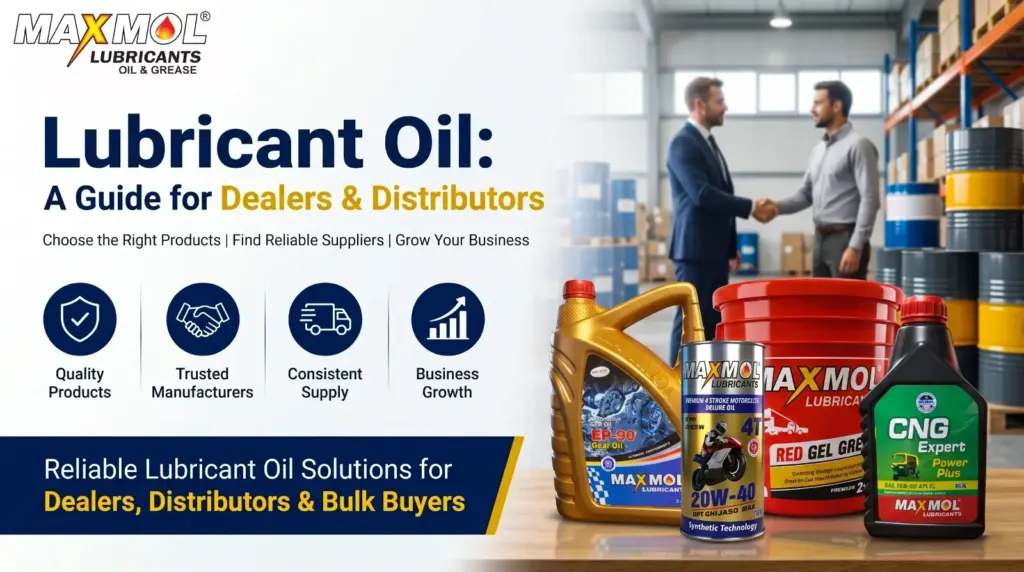
MAXMOL Lubricants lubricant oil solutions for dealers, distributors and bulk buyers, featuring automotive gear oil, 20W-40 bike engine oil, red gel grease and CNG engine oil products.

Lubricant Oil: A Guide for Dealers and Distributors in India

Lubricant Oil: A Guide for Dealers and Distributors in India The demand for lubricant oil creates business opportunities for dealers, distributors, retailers, workshops, and bulk buyers across India. From motorcycle engine oil and car engine oil to gear oil and automotive grease, lubricants are essential for the maintenance and performance of vehicles and machinery. For businesses planning to enter the lubricant market or expand their existing product range, choosing the right lubricant manufacturer and building a reliable supply network are important steps. Product quality, consistent availability, competitive pricing, and dependable business support can all influence long-term success. In this guide, we explain how dealers and distributors can choose lubricant products, evaluate suppliers, and develop a lubricant business. What Is Lubricant Oil? Lubricant oil is a fluid used to reduce friction between moving parts, help manage heat, and protect components against wear. Depending on its formulation and application, a lubricant can also help control deposits, protect against corrosion, and support equipment performance. Different applications require different lubricant formulations. For example, motorcycle engines, passenger cars, commercial vehicles, and industrial equipment may require different oil grades and specifications. Common lubricant products include: Dealers should understand the applications and specifications of each product before recommending it to customers. Why Is Lubricant Oil a Business Opportunity for Dealers? Lubricants are used across vehicle maintenance, transport, repair, and industrial applications. This gives dealers several potential customer segments to serve, depending on their location, investment capacity, and distribution network. 1. Multiple Customer Segments A lubricant dealer may supply products to motorcycle repair shops, car workshops, spare-parts retailers, garages, fleet operators, and other local businesses. Distributors can build a wider network by supplying smaller dealers and retailers across their assigned markets. 2. A Range of Products to Sell Offering suitable engine oils, gear oils, and grease products can help dealers serve different customer requirements. A carefully selected product range may also create opportunities to develop relationships with repeat buyers. 3. Opportunities to Build Repeat Business Workshops, retailers, and fleet-related businesses may need regular lubricant supplies. Reliable service, suitable product recommendations, transparent pricing, and timely order fulfilment can help build lasting business relationships. 4. Potential for Market Expansion Dealers can start by serving customers in a local area and expand gradually as demand, working capital, and distribution capacity grow. Distributors may develop additional dealer relationships where supply arrangements and market conditions allow. However, business results depend on local competition, customer demand, pricing, credit management, and effective inventory planning. How to Choose the Right Lubricant Manufacturer Selecting a reliable lubricant manufacturer is an important decision for dealers and distributors. The right supplier should offer products suited to your target market and provide clear information to support purchasing and resale. Consider these factors before placing an order. Product Range and Specifications Check whether the manufacturer offers the lubricant categories your customers need. Review viscosity grades, applicable performance specifications, product applications, packaging sizes, and technical documentation. Never recommend an oil solely because its viscosity grade matches another product. Always check the vehicle or equipment manufacturer’s requirements. Product Quality and Documentation Ask for relevant product technical data sheets, specifications, and applicable quality documentation. Verify performance claims and approvals where required, and ensure products are suitable for their intended applications. Pricing and Order Requirements Compare quotations based on the same product grade, pack size, quantity, applicable taxes, freight, and payment terms. A low purchase price does not automatically mean better profitability. Supply Consistency Ask about stock availability, dispatch timelines, minimum order quantities, and the process for handling shortages or damaged goods. Reliable replenishment helps dealers plan inventory and serve customers efficiently. Dealer and Distributor Support Discuss product information, sales materials, enquiry handling, territory arrangements, and any available promotional support. Confirm all commercial terms in writing before committing to a dealership or distribution arrangement. How to Find Reliable Lubricant Oil Suppliers in India When searching for lubricant oil suppliers, dealers should evaluate more than the advertised price. A supplier’s product range, business credentials, supply arrangements, and responsiveness can affect daily operations. Use the following steps: A supplier should be able to explain its products and commercial terms clearly. Avoid relying on unverified claims about guaranteed profits, exclusive territories, or assured sales. Lubricant Company in India: What Should Dealers Look For? A lubricant company in India may serve different markets through its product portfolio, dealer network, distributors, and direct business relationships. The most suitable company for your business depends on your customers and the type of distribution arrangement you want. Before selecting a company, consider: Dealers should assess the complete business arrangement rather than choosing a company on brand name or price alone. Lubricant Distributor vs. Lubricant Dealer: What Is the Difference? Although the terms are sometimes used interchangeably, a lubricant distributor and a lubricant dealer may operate at different levels of the supply chain. Factor Lubricant distributor Lubricant dealer Main role Supplies products to dealers, retailers, or other business customers Sells products to local retailers, workshops, or end customers Typical coverage May serve multiple locations or a defined territory Often focuses on a local market Inventory May manage larger stock volumes Usually manages stock based on local demand Customer relationships Builds and maintains a network of business buyers Develops relationships with workshops and local customers Key considerations Supply planning, working capital, logistics, and network development Product selection, local sales, stock rotation, and customer service These roles are not fixed across every company. Actual responsibilities depend on the manufacturer’s or supplier’s distribution policy. How to Start a Lubricant Oil Dealership Starting a lubricant dealership requires market research, supplier selection, investment planning, and customer development. Step 1: Research Local Demand Visit workshops, garages, spare-parts shops, and other potential business customers. Understand which products they purchase, which pack sizes they prefer, and how frequently they reorder. Step 2: Select Your Product Mix Start with products that match verified customer requirements. Avoid purchasing a large quantity of every available grade before understanding local demand. Step 3: Calculate Your Working Capital Include inventory, transportation, storage, rent, staff expenses, taxes,

Lubricant Oil: A Guide for Dealers and Distributors in India Read More »
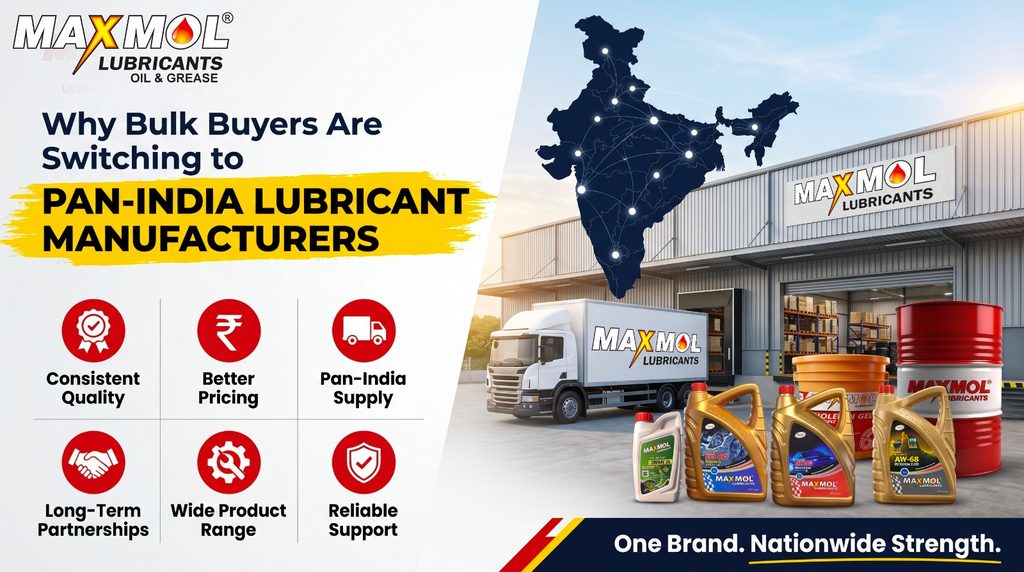
MAXMOL Lubricants showcasing pan-India lubricant manufacturing and supply, with a nationwide distribution map, delivery truck, lubricant drums, and engine oil products.

Why Bulk Buyers Are Switching to Pan-India Lubricant Manufacturers

The lubricant industry in India is undergoing a significant shift. Bulk buyers who once depended primarily on local lubricant suppliers and regional manufacturers are increasingly looking toward Pan-India lubricant manufacturers for their large-volume requirements. From automotive workshops and transport fleets to industrial units, distributors, dealers, and OEM support networks, buyers are becoming more strategic about where they source lubricants. Price is still important, but it is no longer the only deciding factor. Consistent quality, reliable supply, technical support, product availability, and nationwide distribution have become equally important. 1. Consistent Product Quality Across Locations or bulk buyers, consistency is critical. When lubricants are purchased in large quantities from different regional suppliers, there can be variations in formulation, performance, packaging, and batch quality. These variations can create problems for businesses operating across multiple locations. Pan-India lubricant manufacturers generally offer standardized formulations and manufacturing processes. This allows buyers to source the same product specification across different regions. For a fleet operator, industrial company, or distributor, this means greater confidence that the lubricant being delivered in Delhi will perform consistently with the same product supplied in Mumbai, Bengaluru, Kolkata, or Ahmedabad. Consistency reduces operational uncertainty—and that has real business value. 2. Better Supply Chain Reliability Bulk buyers cannot afford frequent stock-outs. A lubricant may be an essential consumable for commercial fleets, manufacturing plants, construction equipment, agricultural machinery, and automotive service businesses. Delayed deliveries can result in equipment downtime and operational losses. Pan-India manufacturers typically have broader distribution networks, regional warehouses, channel partners, and established logistics systems. This allows bulk buyers to benefit from: For procurement teams, a reliable supply chain can be just as important as the product itself. 3. Competitive Pricing for Large-Volume Orders Bulk purchasing is fundamentally about achieving better economics. Pan-India manufacturers often operate at larger production volumes, allowing them to optimize manufacturing, packaging, procurement, warehousing, and logistics. These efficiencies can translate into more competitive pricing for bulk customers. However, smart buyers are looking beyond the per-litre purchase price. The real question is: What is the total cost of ownership? A slightly cheaper lubricant may not necessarily be cheaper if it results in higher consumption, shorter drain intervals, equipment wear, inconsistent performance, or frequent replacement. Bulk buyers are therefore increasingly evaluating price alongside performance, reliability, and service. 4. Wider Product Portfolio Under One Roof Another major advantage is product range. Different applications require different types of lubricants. A single business may need engine oils, gear oils, hydraulic oils, transmission fluids, greases, coolants, and specialty industrial lubricants. Working with multiple small suppliers can make procurement complicated. A Pan-India lubricant manufacturer can potentially provide a broader portfolio from a single source. This simplifies: For large distributors and industrial buyers, consolidating suppliers can significantly simplify procurement operations. 5. Stronger Technical Support Modern lubricant purchasing is becoming more technical. Bulk buyers increasingly want more than a product catalogue. They want help selecting the right lubricant for specific equipment, operating conditions, temperatures, loads, and applications. Established lubricant manufacturers can provide technical information such as: This technical support helps buyers make better purchasing decisions and avoid costly lubricant-selection mistakes. 6. Better Documentation and Quality Assurance For professional procurement teams, documentation matters. Large businesses may require product specifications, batch information, test reports, safety documentation, certifications, and other quality-related records as part of their vendor evaluation process. Pan-India manufacturers that have established quality-management systems are generally better positioned to support structured procurement requirements. For bulk buyers, this creates greater transparency and confidence throughout the purchasing process. 7. Nationwide Distribution Creates Business Continuity One of the biggest lessons businesses have learned in recent years is the importance of supply-chain resilience. Depending heavily on one local supplier can create vulnerabilities. Transportation disruptions, production interruptions, raw-material shortages, or regional demand spikes can affect product availability. A manufacturer with a wider geographical presence can provide greater flexibility. If demand increases in one market, a broader distribution network can potentially help maintain supply through alternative production or distribution channels. For businesses purchasing thousands of litres of lubricant, this level of supply security can be a major advantage. 8. Private Label and Customized Solutions Many distributors and large buyers are also looking for opportunities to build their own brands. Pan-India lubricant manufacturers with suitable manufacturing capabilities may offer private-label and contract manufacturing solutions. This allows businesses to market lubricants under their own brand while leveraging an established manufacturer’s: For distributors looking to expand their product portfolio, private-label manufacturing can create an additional growth opportunity. 9. Growing Demand for Long-Term Supplier Partnerships Bulk purchasing is no longer simply a transaction. Large buyers want suppliers who can grow with their business. A reliable lubricant manufacturing partner can help businesses with forecasting, product selection, inventory planning, technical support, and new product requirements. This is particularly valuable for distributors and fleet operators whose lubricant consumption can increase significantly as their operations expand. Instead of constantly searching for the lowest-priced supplier, businesses are increasingly asking: Can this manufacturer become a dependable long-term partner? 10. The Shift from “Cheapest Supplier” to “Best Value Supplier” Perhaps the biggest change in bulk lubricant procurement is the way buyers define value. Previously, purchasing decisions were often dominated by price. Today, experienced buyers consider a wider range of factors: Product quality + supply reliability + technical support + consistency + logistics + pricing = Total Value This shift is particularly important for businesses where lubricant performance directly affects equipment life and operating costs. A reliable lubricant supplier can help reduce unexpected maintenance, improve operational efficiency, and simplify procurement. Why This Trend Is Likely to Continue India’s automotive, transportation, manufacturing, infrastructure, agriculture, and industrial sectors continue to create substantial demand for lubricants. As businesses become more organized and procurement becomes increasingly data-driven, bulk buyers will continue looking for suppliers that can provide scale, consistency, reliability, and value. This is where Pan-India lubricant manufacturers have a clear advantage. They are not simply selling lubricant products—they are increasingly becoming supply-chain and technical partners for businesses across the country. Final Thoughts The shift toward Pan-India lubricant manufacturers is

Why Bulk Buyers Are Switching to Pan-India Lubricant Manufacturers Read More »

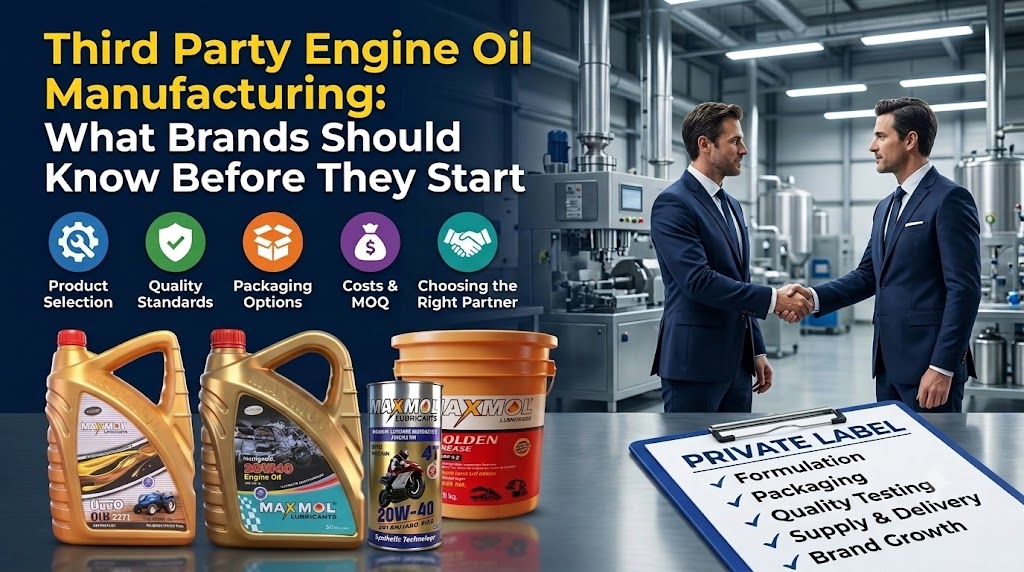
Third party engine oil manufacturing for private-label lubricant brands

Third Party Engine Oil Manufacturing: What Brands Should Know Before They Start

Starting your own engine oil brand can be an attractive business opportunity in India’s growing automotive and lubricant market. However, setting up a complete engine oil manufacturing plant requires significant investment in land, machinery, blending equipment, storage facilities, laboratories, raw materials, manpower and regulatory compliance. This is where a third-party engine oil manufacturing can provide an alternative. Through third-party manufacturing, a business can launch engine oil products under its own brand without necessarily establishing its own manufacturing facility. An experienced engine oil manufacturer in India produces the lubricant according to agreed product specifications, while the brand owner focuses on branding, marketing, sales and distribution. However, choosing a third-party manufacturer is an important business decision. Product quality, formulation, packaging, minimum order quantity, pricing, documentation and supply reliability can all affect the success of your brand. In this guide, we explain third party engine oil manufacturing, how the process works, what brands should check before starting and how to choose a suitable manufacturing partner. What Is Third Party Engine Oil Manufacturing? Third party engine oil manufacturing is a business arrangement where one company manufactures engine oil products for another company or brand. The brand owner sells the finished product under its own brand name, while the manufacturing partner handles the agreed manufacturing activities. For example, suppose you want to launch your own motorcycle engine oil brand. Instead of building your own lubricant manufacturing plant, you can work with a third party engine oil manufacturer that has suitable production and quality-control facilities. The manufacturer can produce the required engine oil according to the agreed specifications and packaging requirements. The brand owner can then focus on: This model is also commonly associated with private label engine oil manufacturing. Why Are Brands Choosing Third Party Engine Oil Manufacturing? The lubricant business requires more than simply buying base oil and adding additives. A commercial manufacturing operation needs appropriate infrastructure, production systems, quality-control processes, storage arrangements and technical expertise. For a new business, building this infrastructure from the beginning can require considerable capital. With third party engine oil manufacturing, businesses can outsource production and allocate more resources toward market development. Some of the potential advantages include: 1. Lower Manufacturing Infrastructure Investment Building a manufacturing facility requires investment in production equipment, storage tanks, laboratories, utilities, safety systems and other infrastructure. Third-party manufacturing allows a brand to use an established manufacturer’s facilities instead of building all manufacturing infrastructure itself. 2. Faster Brand Development A business can concentrate on creating its brand identity, packaging and distribution network while the manufacturing partner manages production. The actual launch timeline depends on formulation selection, packaging development, order quantities, testing and production schedules. 3. Access to Manufacturing Expertise An experienced lubricant manufacturer may have knowledge of different lubricant formulations, raw materials, blending processes, testing procedures and packaging requirements. This can be useful for businesses entering the lubricant market for the first time. 4. Focus on Sales and Distribution Instead of managing every part of production, the brand can focus on selling its products through: Who Can Start an Own Engine Oil Brand? Third-party manufacturing is not limited to large companies. Depending on the manufacturer’s requirements and applicable regulations, the model may be suitable for: For example, an established automotive spare parts distributor may decide to introduce its own motorcycle engine oil brand to its existing dealer network. Similarly, a lubricant distributor may want to develop a private-label product range instead of selling only other companies’ brands. How Does Third Party Engine Oil Manufacturing Work? The process can vary from one manufacturer to another, but a typical third party engine oil manufacturing process can involve the following stages. Step 1: Understand Your Target Market Before selecting an engine oil manufacturer, first determine who you want to sell to. Your target market could include: Your target market will influence your product range, packaging, pricing and distribution strategy. For example, if your primary customers are motorcycle workshops and spare parts dealers, your initial product range may focus on motorcycle engine oils rather than launching a large range of industrial lubricants. Step 2: Decide Which Products You Want to Launch The next step is to identify the products required for your brand. Depending on your market and manufacturing partner, your range may include: For engine oils, viscosity grades such as 10W-30, 10W-40, 15W-40, 20W-40 and 20W-50 may be relevant to different applications. However, the correct product should always be selected according to the intended vehicle or equipment application and applicable manufacturer and industry specifications. Step 3: Discuss Formulation Requirements One of the most important parts of third party engine oil manufacturing is selecting the appropriate formulation. Engine oil performance depends on several factors, including: A manufacturer should be able to explain the available product options and their intended applications. Do not select a formulation simply because another brand is selling it successfully. Your product should be developed or selected according to the requirements of your target application and the claims you intend to make. Step 4: Select Your Packaging Packaging plays an important role in lubricant branding. Depending on the product, market and manufacturer, engine oil may be available in different pack sizes. Common packaging options can include: The exact sizes available will depend on the manufacturer’s packaging capabilities and your target market. You should consider: All packaging should comply with applicable labelling and legal requirements. Step 5: Build Your Brand Identity Third-party manufacturing produces the product, but your brand is what customers see in the market. Before production begins, develop a clear brand identity. This may include: If you intend to build a long-term lubricant business, consider protecting your brand through appropriate intellectual property measures such as trademark registration. Conduct the necessary trademark search and obtain professional advice regarding registration. Step 6: Determine Minimum Order Quantity One of the first questions a new brand should ask a third party engine oil manufacturer is: What is the minimum order quantity? MOQ can vary depending on: A new business should avoid placing an unnecessarily large first order simply

Third Party Engine Oil Manufacturing: What Brands Should Know Before They Start Read More »

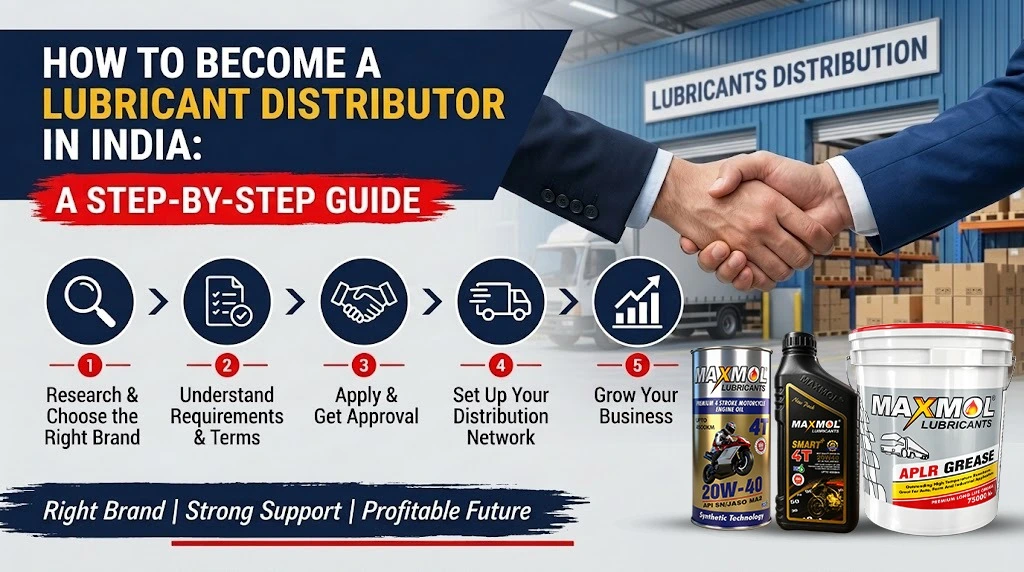
How to become a lubricant distributor in India with step-by-step distribution guide

HOW TO BECOME A LUBRICANT DISTRIBUTOR IN INDIA: A STEP-BY-STEP GUIDE

If you are wondering how to become a lubricant distributor in India, you are looking at one of the country’s most stable trading businesses. Cars, trucks, tractors, factory machines and power equipment all need engine oils, gear oils, hydraulic oils and greases on a regular schedule, so demand keeps coming back. This guide walks you through the whole lubricant distributorship process, from market research and registrations to signing with a brand and scaling up. WHY START A LUBRICANT DISTRIBUTION BUSINESS IN INDIA? – Repeat demand: Oil changes and top-ups happen on fixed schedules, so customers reorder often. – Many types of buyers: Garages, fuel stations, spare-parts shops, transporters, farms and factories all buy lubricants. – Room to grow: You can start with one district and one brand, then add territories, products and sub-dealers. – Brand support: Established companies often provide training, marketing material and sales schemes. There are real challenges too: money locked in stock, credit given to customers, and tough competition from big brands and unorganised players. Plan for these from day one UNDERSTAND THE LUBRICANT MARKET IN INDIA Before investing, learn how the market works. Main segments: 1. Automotive lubricants: Engine oils for two-wheelers, cars and commercial vehicles, plus gear oils, transmission fluids, brake fluids and coolants. This is the largest segment. 2. Industrial lubricants: Hydraulic, compressor and turbine oils, metalworking fluids and greases for factories and heavy machinery. 3. Marine and specialty lubricants: A niche segment with higher technical demands. Major players: – PSU brands: IndianOil (Servo), BPCL (Mak), HPCL (HP Lubricants) Become a Distributor – Private and multinational brands: Castrol, Shell, Gulf, Valvoline, Motul, Veedol and others – Regional blenders: Smaller companies serving particular states or industries Action: Visit garages, fuel stations and spare-parts shops near you. Note which brands are sold, their price points and which are missing. Those gaps are your opportunity. CHOOSE YOUR SEGMENT AND TERRITORY You cannot serve everyone at the start. Decide who you will sell to based on your contacts and local demand. Ask yourself: – Do I know garage owners, transporters or factory managers in my region? – Is my area strong in commercial vehicles, agriculture, two-wheelers or manufacturing? – Do I want to focus on retail outlets or on industrial (B2B) customers? A distributor in an industrial belt such as Pune or Ludhiana will focus differently from one in a farming district where tractor and pump oils dominate. PICK YOUR BUSINESS MODEL 1. Authorised distributor of an established brand    You get a defined territory, brand support and a set pricing structure.    Best for: Beginners who want credibility. 2. Distributor of a regional or emerging brand    Easier entry and often higher margins, but weaker brand pull.    Best for: People with strong local networks. 3. Private-label trading    A third-party blender makes oil under your own brand.    Best for: Experienced entrepreneurs with capital and a marketing plan. Most first-timers do best as an authorised distributor of a known or fast-growing brand. COMPLETE REGISTRATIONS, LICENSES AND DOCUMENTS Here are the documents typically required for a lubricant distributorship: 1. Business structure: Proprietorship, partnership, LLP or private limited company. A proprietorship is the fastest to set up, while a company or LLP builds more trust with brands and banks. 2. PAN of the business or proprietor. 3. GST registration: Required for trading. Lubricating oils are generally taxed at 18% GST, but confirm the current rate and HSN code with a chartered accountant. 4. Udyam (MSME) registration: Optional, but helpful for loans and scheme benefits. 5. Shop and Establishment or trade license from your local authority. 6. Current bank account in the business name. 7. Warehouse approvals: Check local fire-safety and municipal rules for storage. They vary by state and quantity stored. 8. Legal Metrology awareness: Packaged goods must follow labelling and declaration rules. Brands handle this for their own packs, but it matters if you sell under your own label. Requirements differ by state, so consult a local CA or company secretary before filing. PLAN YOUR LUBRICANT DISTRIBUTORSHIP INVESTMENT Investment depends on the brand, territory and scale. Budget for: – Opening stock (working capital): The largest cost. Many brands require a minimum first order or a security deposit. – Warehouse or godown: Rent or purchase, plus racks and pallets. – Delivery vehicle: A small pickup or commercial vehicle. – Staff: A salesperson, warehouse helper and possibly an accountant. – Software, signage and marketing. – Buffer capital: To cover customer credit and delayed payments. Small distributorships often start with a few lakh to tens of lakhs of rupees, while large territorial appointments with major brands can need much more. Always ask each brand for its exact requirements instead of relying on general figures. HOW TO GET A LUBRICANT DISTRIBUTORSHIP FROM A BRAND This is the most important step. Follow this process: 1. Shortlist 5 to 10 brands that suit your territory and customers. 2. Check their websites for a “Become a Distributor” or “Business Enquiry” page. 3. Attend trade shows on automotive, lubricants and industrial supply to meet company representatives. 4. Contact regional sales managers by email or LinkedIn. 5. Submit a strong proposal that includes:    – Your background and experience    – Proposed territory and target segments    – Existing customer network    – Warehouse, vehicle and staff details    – Financial capacity and bank references    – A 12-month sales plan with volume targets Brands choose distributors who show market knowledge, financial stability and growth potential. WARNING: Be careful with anyone demanding a large “registration fee” or “franchise fee” upfront without a clear written agreement. Verify the company, visit its office or plant if you can, and read the contract before paying. NEGOTIATE AND SIGN THE DISTRIBUTOR AGREEMENT Have a lawyer review the agreement. Check these points: – Territory exclusivity: Is your area exclusive or shared? – Margins and pricing: Your margin, price lists and how price changes are communicated – Minimum purchase or volume targets and penalties for missing them – Credit terms and security deposit – Returns, replacements and damaged-goods policy – Schemes, incentives and

HOW TO BECOME A LUBRICANT DISTRIBUTOR IN INDIA: A STEP-BY-STEP GUIDE Read More »

Shopping Cart
WhatsApp

BECOME A
DISTRIBUTOR

Partner with Maxmol Lubricants and grow your business with our quality lubricant products and reliable distribution opportunities.

✓ Attractive Distributor Margins
✓ Premium Quality Lubricant Products
Become A Distributor