
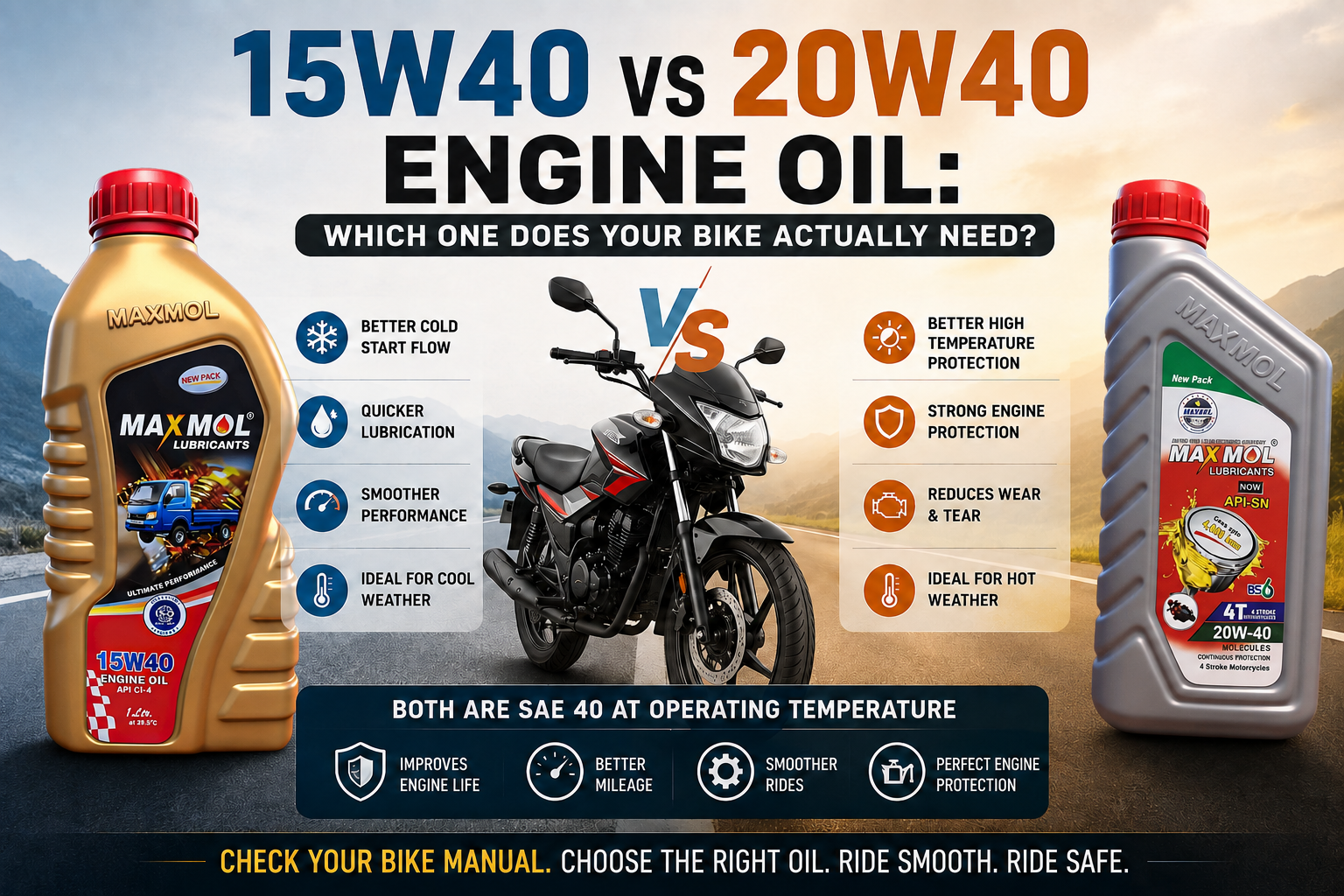
Choosing the right engine oil is one of the most important parts of motorcycle maintenance. The right oil helps keep the engine lubricated, supports smooth performance, and protects important engine components from wear. But when you see different viscosity grades such as 15W40 and 20W40, it can be difficult to know which one is right for your bike.
So, 15w40 vs 20w40 engine oil—what is the actual difference, and which one should you use?
Both are commonly discussed engine oil grades, but they behave differently at lower temperatures. Understanding their viscosity ratings can help you make a better decision when choosing bike engine oil.
What Does 15W40 vs 20W40 Engine Oil Mean?
To understand 15w40 vs 20w40 engine oil, you first need to understand what the numbers mean.
Engine oil viscosity is represented by two numbers. The first number, followed by the letter W, indicates how the oil behaves at lower temperatures. The second number indicates its viscosity at higher operating temperatures.
For example:
- 15W40: 15W represents its low-temperature viscosity rating, while 40 represents its high-temperature viscosity grade.
- 20W40: 20W represents its low-temperature viscosity rating, while 40 represents its high-temperature viscosity grade.
The W means winter, not weight.
The major difference between these two grades is therefore their low-temperature behavior. Both have a 40-grade viscosity at operating temperature.
15W40 Engine Oil Explained
15W40 engine oil is designed to flow more easily at lower temperatures compared with 20W40.
This can be useful during cold starts because engine oil needs to circulate through the engine after the motorcycle is started. Faster oil circulation can help provide lubrication to engine components.
Some potential characteristics of 15W40 engine oil include:
- Better low-temperature flow than 20W40
- Easier circulation during cold starts
- Suitable for applications where 15W40 is recommended
- Available in different formulations for different engine requirements
However, choosing 15W40 simply because it has a lower first number is not always the right decision. Your motorcycle manufacturer’s recommended viscosity should always come first.
20W40 Engine Oil Explained
20W40 engine oil has a higher low-temperature viscosity rating than 15W40. This means it is slightly thicker during colder conditions.
At normal engine operating temperature, however, both 15W40 and 20W40 have a 40-grade viscosity.
20W40 may be suitable for motorcycles that specifically require this viscosity grade. It can provide the lubrication characteristics expected by an engine designed around that specification.
Before using 20W40 motorcycle engine oil, check your owner’s manual to confirm that the viscosity and performance specifications match your bike.
15W40 vs 20W40 Engine Oil: Key Difference
The biggest difference in 15w40 vs 20w40 engine oil is their low-temperature viscosity.
15W40 is designed to flow more easily at lower temperatures, while 20W40 is slightly thicker under the same conditions.
At normal operating temperatures, both oils are SAE 40 grade.
|
Feature |
15W40 Engine Oil |
20W40 Engine Oil |
|
Low-temperature flow |
Better |
Slightly thicker |
|
Operating-temperature grade |
SAE 40 |
SAE 40 |
|
Cold-start behavior |
More fluid |
Less fluid than 15W40 |
|
Suitable for bikes |
Depends on manufacturer specification |
Depends on manufacturer specification |
|
Best choice |
When recommended by manufacturer |
When recommended by manufacturer |
Which Is Better for Your Bike: 15W40 or 20W40?
There is no single answer to which oil is better.
The best choice between 15w40 vs 20w40 engine oil depends on your motorcycle manufacturer’s recommendations, engine design, operating conditions, and the required oil specifications.
If your bike’s owner’s manual recommends 15W40, use a suitable 15W40 engine oil.
If it recommends 20W40, choose a quality 20W40 engine oil.
Do not select engine oil only because one grade appears thicker or thinner. Motorcycle manufacturers specify particular viscosity grades based on the engine’s lubrication requirements and expected operating conditions.
Is 15W40 Good for a Motorcycle?
15W40 can be a suitable bike engine oil if your motorcycle manufacturer approves or recommends this viscosity.
Because 15W40 flows more easily than 20W40 at lower temperatures, it may provide better cold-start flow in conditions where that difference matters.
However, viscosity is not the only factor to consider. You should also check the oil’s performance specifications and whether it is suitable for your particular motorcycle.
For motorcycles with wet-clutch systems, make sure the oil is specifically appropriate for motorcycle applications and meets the required specifications.
Is 20W40 Good for a Bike?
Yes, 20W40 can be suitable motorcycle engine oil when it matches your manufacturer’s recommended specification.
It has a 40-grade operating viscosity, just like 15W40. Its main difference is its higher low-temperature viscosity rating.
If your motorcycle manufacturer specifies 20W40, there is generally no reason to change to 15W40 simply because 15W40 has a lower first number.
Always follow the oil grade and specification recommended for your motorcycle.
Does 15W40 Improve Bike Mileage?
A common question about 15w40 vs 20w40 engine oil is whether 15W40 provides better fuel mileage.
Changing from 20W40 to 15W40 does not automatically guarantee better mileage.
Motorcycle fuel economy depends on several factors, including:
- Riding style
- Traffic conditions
- Tyre pressure
- Engine condition
- Motorcycle maintenance
- Rider and luggage weight
- Fuel quality
- Engine oil condition and specification
Using the correct oil grade and changing the oil at the recommended service interval are more important than choosing an oil simply for a potential mileage improvement.
Can You Use 15W40 Instead of 20W40?
Whether you can replace 20W40 with 15W40 depends on your motorcycle manufacturer’s specifications.
Some motorcycles may allow more than one viscosity grade depending on temperature and operating conditions. If your owner’s manual lists both grades as acceptable, either may be suitable within the specified conditions.
However, if your motorcycle specifically requires 20W40 and does not list 15W40 as an approved alternative, it is better to continue using the recommended grade.
The same principle applies when changing from 15W40 to 20W40.
How to Choose the Right Engine Oil for Your Bike
When choosing between 15w40 vs 20w40 engine oil, follow these simple steps:
1. Check the Owner’s Manual
Your motorcycle owner’s manual is the best starting point. Look for the recommended viscosity grade and oil specification.
2. Check the Oil Specifications
Viscosity alone does not determine whether an oil is suitable. Check the performance specifications recommended for your motorcycle.
3. Consider Your Riding Conditions
Think about how you use your bike. Regular city riding, long-distance journeys, frequent starts, heavy traffic, and different temperatures can all affect engine oil requirements.
4. Choose Quality 4T Bike Engine Oil
Always choose a reliable 4T bike engine oil that is suitable for your motorcycle. Avoid selecting oil based only on price or viscosity.
5. Follow the Oil Change Schedule
Even high-quality engine oil needs to be replaced at the recommended service interval. Regular oil changes help maintain proper lubrication and engine performance.
15W40 vs 20W40 Engine Oil: Which One Should You Choose?
So, 15w40 vs 20w40 engine oil—which one does your bike actually need?
The safest answer is to follow the viscosity grade and oil specification recommended by your motorcycle manufacturer.
15W40 offers better low-temperature flow characteristics than 20W40, while both have an SAE 40 operating-temperature grade. But that does not mean 15W40 is automatically better for every motorcycle.
If your motorcycle recommends 15W40, choose a quality 15W40 engine oil. If it recommends 20W40, use a suitable 20W40 engine oil.
The correct engine oil is the one that matches your motorcycle’s requirements—not simply the oil with the higher or lower number.
FAQ
Neither is universally better. The right choice depends on the motorcycle manufacturer’s recommended viscosity and oil specifications. 15W40 has better low-temperature flow characteristics than 20W40.
Only if 15W40 is approved or listed as an acceptable viscosity for your motorcycle. Always check the owner’s manual before changing oil viscosity.
The main difference is their low-temperature viscosity. 15W40 flows more easily at lower temperatures than 20W40. Both have a 40-grade viscosity at operating temperature.
Final Verdict
Understanding 15w40 vs 20w40 engine oil makes it easier to choose the right lubricant for your motorcycle.
15W40 and 20W40 are both SAE 40-grade oils at operating temperature, but 15W40 has a lower low-temperature viscosity rating and can flow more easily during cold starts.
However, you should not choose engine oil based on viscosity alone. Check your motorcycle owner’s manual, use the recommended specification, choose quality motorcycle engine oil, and follow the recommended oil-change interval.
When it comes to protecting your bike’s engine, the right specification matters more than simply choosing 15W40 or 20W40.