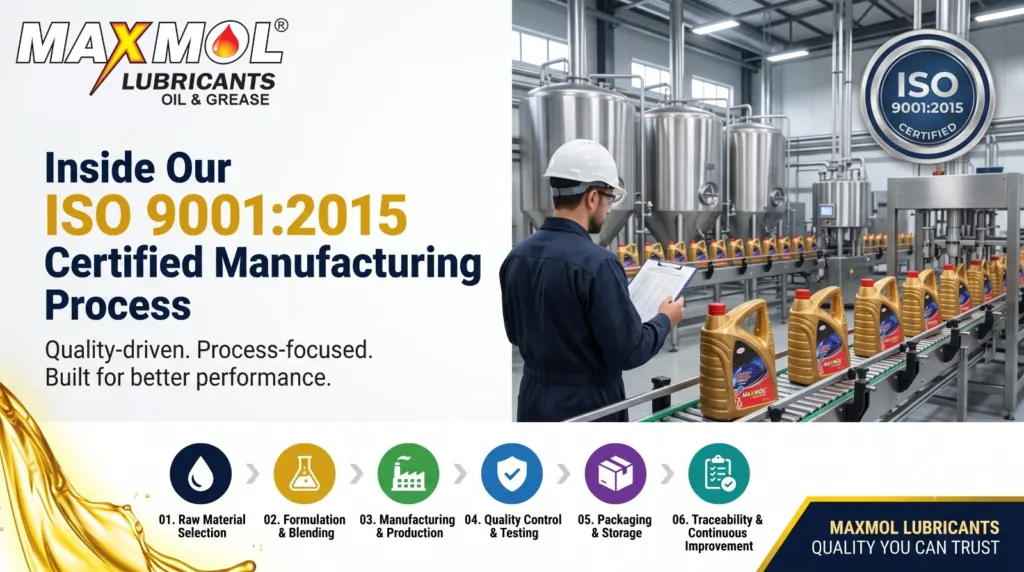
Inside Our ISO 9001:2015 Certified Manufacturing Process
In the lubricant industry, product quality, consistency, and reliability are essential for building long-term customer trust. At MAXMOL Lubricants, we understand the importance of maintaining high-quality standards throughout every stage of manufacturing. Our approach focuses on systematic production practices, quality-conscious operations, and continuous improvement to meet the evolving requirements of customers across India. Our ISO 9001:2015 certified manufacturing process reflects our commitment to a structured quality management system. From raw material evaluation to production monitoring and final product inspection, every stage plays an important role in delivering lubricants that meet defined quality requirements. In this article, we take you inside our manufacturing process to explain how quality management, production discipline, and systematic checks contribute to reliable lubricant manufacturing. What Does ISO 9001:2015 Certification Mean for Manufacturing? ISO 9001:2015 is an internationally recognized quality management system standard developed by the International Organization for Standardization (ISO). It provides a framework that helps organizations establish consistent processes, monitor performance, manage risks, and improve customer satisfaction. For lubricant manufacturers, a quality management system can help bring greater control and consistency to production activities, documentation, supplier evaluation, and product quality checks. At MAXMOL Lubricants, our focus on quality management supports a systematic approach to manufacturing and encourages continuous improvement across operational activities. Note: ISO 9001:2015 certification relates to an organization’s quality management system. It does not automatically certify every individual lubricant product or guarantee that every product meets a particular technical specification. 1. Raw Material Selection and Evaluation Quality manufacturing begins with the selection of suitable raw materials. The performance and consistency of lubricants depend on the quality of their base oils, additives, and other formulation components. A systematic raw material evaluation process helps manufacturers assess incoming materials against applicable requirements before they enter production. Important considerations may include: By following documented material-handling and evaluation procedures, lubricant manufacturers can help minimize inconsistencies and maintain better control over the production process. 2. Controlled Lubricant Formulation Lubricant formulation is a critical stage in manufacturing. Different applications require different performance characteristics, viscosity grades, and additive combinations. Engine oils, gear oils, hydraulic oils, industrial lubricants, automotive greases, and coolants each have specific formulation requirements depending on their intended use. A controlled formulation process involves following established manufacturing instructions, using appropriate materials, and maintaining consistency between production batches. Depending on the product, formulation parameters may include: Careful control of formulation parameters helps support product consistency and suitability for the intended application. 3. Systematic Manufacturing and Blending The blending stage brings selected ingredients together according to the relevant product formulation and manufacturing instructions. In lubricant production, the blending process must be managed carefully to achieve the required characteristics. Depending on the formulation, this may involve controlled mixing, monitoring of processing conditions, and checks to ensure that the batch follows established requirements. A systematic manufacturing process can help reduce avoidable variation, improve operational efficiency, and support repeatable production outcomes. For MAXMOL Lubricants, a quality-focused manufacturing approach means treating process control as an essential part of delivering dependable lubricant solutions. 4. Quality Control and Product Testing Quality control is one of the most important aspects of lubricant manufacturing. Testing and inspection help determine whether materials and finished products meet the applicable acceptance criteria. Depending on the product type and specification, lubricant quality checks may include: Not every test applies to every product. The appropriate testing requirements depend on the formulation, product category, intended application, and relevant specifications. A structured quality management system also supports the documentation of inspection results, the handling of nonconforming materials or products, and corrective action when issues are identified. These measures help manufacturers maintain better control over product quality and identify opportunities for improvement. 5. Batch Identification and Traceability Manufacturing consistency is not only about producing a quality product; it is also about maintaining appropriate records throughout the production process. Batch identification and traceability help connect production records with relevant raw materials, manufacturing activities, inspection results, and finished product details. An effective traceability system can support: Maintaining suitable records helps manufacturers investigate issues more efficiently and strengthen accountability across manufacturing operations. 6. Safe Storage and Packaging After manufacturing and the required quality checks, finished lubricants move to the applicable storage and packaging stages. Proper packaging helps protect products during storage, transportation, and distribution. Packaging requirements vary according to the lubricant type, container design, and intended market. Important considerations include suitable container selection, packaging integrity, accurate product identification, batch details, and appropriate storage conditions. An organized packaging and storage process helps reduce the risk of product mix-ups, leakage, contamination, and handling-related issues. For distributors, dealers, workshops, fleet operators, and industrial buyers, clear identification and dependable product handling are important parts of the overall supply experience. 7. Documentation and Continuous Improvement ISO 9001:2015 emphasizes a process-based approach to quality management, performance evaluation, risk-based thinking, and continual improvement. Manufacturing organizations can use documented procedures, internal audits, performance monitoring, customer feedback, and corrective actions to identify areas where processes can be improved. For lubricant manufacturing, these practices may help improve process consistency, reduce avoidable errors, strengthen supplier coordination, and enhance customer service. Continuous improvement is an ongoing responsibility rather than a one-time activity. Reviewing processes regularly helps organizations respond to changing customer expectations and operational requirements. Why Quality Management Matters When Choosing a Lubricant Manufacturer Choosing the right lubricant manufacturer involves more than comparing prices. Businesses need a supplier that understands the importance of product consistency, reliable communication, appropriate specifications, and dependable supply. A structured quality management system can provide useful evidence of an organization’s commitment to controlled processes and continual improvement. When evaluating a lubricant manufacturer, buyers should consider: For distributors, dealers, workshops, transport fleets, and industrial businesses, these considerations can help support more informed sourcing decisions. MAXMOL Lubricants: A Commitment to Quality-Focused Manufacturing At MAXMOL Lubricants, we recognize that quality is an important part of building lasting relationships with customers and business partners. Our manufacturing approach focuses on process discipline, product requirements, quality management, and continuous improvement. Whether businesses are sourcing automotive lubricants, engine oils, industrial lubricants, greases, or coolant
Inside Our ISO 9001:2015 Certified Manufacturing Process Read More »