
Table of Contents
- What Is API SL Certification?
- What Does API Mean in Engine Oil?
- What Does API SL Mean?
- What Is API SN?
- What Is API SP?
- API SL vs SN vs SP
- Is API SP Better Than API SN and SL?
- API Rating vs Engine Oil Viscosity
- Benefits of API SL Engine Oil
- Is API SL Suitable for Bikes?
- Is API SL Suitable for Cars?
- Does API SL Mean Fully Synthetic Oil?
- How to Choose the Right Engine Oil
- Frequently Asked Questions
- Final Thoughts
What is API SL Certification?
API SL is a performance classification for gasoline or petrol engine oils under the American Petroleum Institute’s engine oil classification system.
Here, API stands for American Petroleum Institute. The API engine oil classification system helps identify the performance level of lubricants designed for different engine requirements.
The SL in API SL identifies a specific gasoline-engine performance category.
In simple terms, API SL tells you about the performance requirements that an engine oil is designed to meet.
It is important to understand that API SL is not a viscosity grade.
For example:
In this example:
- 20W-40 is the viscosity grade.
- API SL is the engine oil performance category.
Therefore, API SL and 20W-40 provide two different types of information about the oil.
API means American Petroleum Institute.
In the engine oil industry, API classifications are used to identify performance categories for lubricants.
For gasoline engines, you may see API categories such as:
- API SJ
- API SL
- API SM
- API SN
- API SP
These categories have evolved over time as engine technology and lubricant performance requirements have changed.
This is why understanding API SL vs SN vs SP is useful when comparing engine oils.
However, API classification is only one part of choosing the correct engine oil. You should also consider the viscosity grade and the vehicle manufacturer’s specifications.
API SL is an established gasoline-engine oil performance category.
Engine oils meeting the API SL requirements are designed to provide performance in areas such as:
- Engine wear protection
- Deposit control
- Oxidation resistance
- Sludge control
- High-temperature performance
- Engine cleanliness
API SL was introduced for gasoline engines and has been used in many vehicle applications.
However, API SL alone does not determine whether an oil is suitable for every vehicle.
Before choosing an API SL engine oil, check the manufacturer’s recommended:
- Viscosity
- API category
- Additional specifications
- Manufacturer approvals
The complete oil specification should match your vehicle’s requirements.
SN is a newer gasoline-engine oil performance category than API SL.
API SN was developed to address updated requirements for gasoline engines and provide performance in areas such as:
- Engine wear protection
- Deposit control
- Oxidation resistance
- Engine cleanliness
- High-temperature performance
The general progression of gasoline-engine API categories includes:
API SL → API SM → API SN
Therefore, API SN reprAPI esents a later generation of performance requirements than API SL.
However, a newer API category should not automatically be assumed to be suitable for every vehicle. Always check the vehicle manufacturer’s recommendations.
API SP is a newer gasoline-engine oil performance category developed for modern petrol engines.
Modern engines can operate under demanding conditions due to technologies such as:
- Turbocharging
- Direct fuel injection
- Engine downsizing
- Higher power output
- Advanced timing systems
API SP addresses modern engine protection requirements, including areas such as:
- Low-Speed Pre-Ignition (LSPI)
- Timing-chain wear
- High-temperature deposits
- Oxidation
- Sludge and varnish control
- Engine wear
For vehicles that specifically require API SP, using an engine oil that meets the required API SP specification is important.
One of the most common questions is:
What is the difference between API SL, SN and SP?
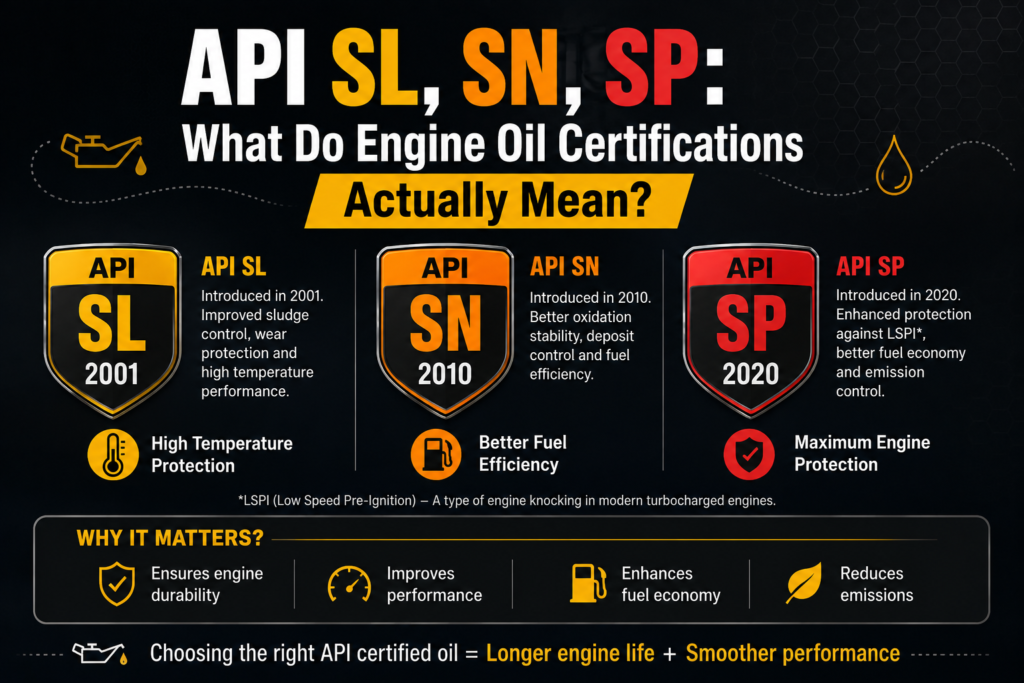
The simplest way to understand these ratings is to view them as different generations of gasoline-engine oil performance classifications.
| API Category | General Position | Main Focus |
| API SL | Earlier category | Wear, deposits and oxidation protection |
| API SN | Newer category | Updated engine protection and deposit control |
| API SP | Newer generation | Modern engine protection, including LSPI and timing-chain wear requirements |
The general progression is:
API SL → API SM → API SN → API SP
As engine technology has developed, lubricant performance requirements have also evolved.
However, this does not mean that every vehicle needs API SP. The correct API category depends on the engine manufacturer’s requirements.
API SP is a newer gasoline-engine performance category than API SN and API SL.
It was developed to address additional performance requirements associated with modern engines.
For example, API SP includes requirements related to:
- LSPI protection
- Timing-chain wear
- Deposit control
- Oxidation
- Engine wear
Therefore, API SP represents a newer level of gasoline-engine oil performance requirements.
But there is an important point:
The newest API category is not automatically the correct oil for every engine.
Always follow the vehicle manufacturer’s recommended API specification and viscosity grade.
A common mistake is confusing API ratings with engine oil viscosity.
They are completely different specifications.
API Rating
Examples include:
- API SL
- API SN
- API SP
These describe the oil’s performance classification.
Viscosity Grade
Examples include:
These describe the oil’s viscosity characteristics.
Example
Suppose an engine oil label says:
15W-40 API SL
This means:
15W-40 = viscosity grade
API SL = performance category
Therefore, API SL does not tell you whether an oil is 10W-40, 15W-40, or 20W-40.
Both viscosity and performance requirements should be checked before selecting engine oil.
If your vehicle requires an API SL performance category, an appropriate API SL engine oil can provide important areas of engine protection.
1. Engine Wear Protection
Engine components operate under high temperatures, pressure, and friction.
Engine oil creates a lubricating film between moving components, helping reduce friction and wear.
2. Deposit Control
Engine oil is exposed to heat and combustion-related contaminants.
A properly formulated lubricant helps control deposits and maintain engine cleanliness.
3. Oxidation Resistance
High temperatures can accelerate oil oxidation.
Suitable oxidation resistance helps maintain lubricant performance under appropriate operating conditions.
4. Sludge Control
Sludge can develop from oil degradation, contaminants, moisture, and combustion by-products.
Proper engine oil performance helps control sludge and unwanted deposits.
5. High-Temperature Performance
Engine oil must continue to perform under demanding operating temperatures.
Appropriate performance characteristics help protect engine components during normal and demanding operation.
Whether API SL is suitable for a motorcycle depends on the manufacturer’s requirements.
Motorcycles can have specific lubrication requirements because, in many designs, the same oil may lubricate the:
- Engine
- Clutch
- Transmission
Therefore, when choosing API SL bike engine oil or API SL motorcycle engine oil, you should not look at API SL alone.
Also check:
- Recommended viscosity
- API specification
- JASO specification
- Motorcycle manufacturer’s recommendation
- Engine type
For example, a motorcycle may require 10W-30, 10W-40, 15W-40, or 20W-40, depending on the manufacturer’s specifications.
A suitable motorcycle oil may also need to meet an appropriate JASO requirement.
API SL may be suitable for certain petrol cars, particularly applications that specify or allow this performance category.
However, newer vehicles may require newer API categories or specific manufacturer approvals.
Before using API SL engine oil in a car, check:
- Recommended viscosity
- Required API category
- Manufacturer approvals
- Engine type
- Vehicle manufacturer’s oil recommendations
The correct engine oil is the one that meets the specifications required for your particular engine.
Choosing the right engine oil is easier when you check the specifications in the correct order.
Step 1: Check the Owner’s Manual
Start by checking the vehicle manufacturer’s recommended engine oil specification.
Step 2: Check the Viscosity
Look for the recommended viscosity, such as:
5W-30, 10W-30, 10W-40, 15W-40, or 20W-40.
Step 3: Check the API Rating
Check whether your vehicle requires API SL, API SN, API SP, or another performance category.
Step 4: Check Additional Standards
For motorcycles, check whether a JASO specification is required.
For cars, check whether the manufacturer requires additional approvals or specifications.
Step 5: Consider Operating Conditions
Driving conditions can also influence engine oil requirements.
Examples include:
- Heavy traffic
- High temperatures
- Frequent short trips
- Dusty environments
- Heavy loads
- High engine operating temperatures
Frequently Asked Questions
API SL certification refers to the API SL gasoline-engine oil performance category. It indicates that the lubricant is designed to meet the performance requirements associated with the API SL classification.
API SL identifies a gasoline-engine oil performance category. It does not describe the oil’s viscosity.
API SP is a newer category than API SL and includes updated requirements for modern engine protection, including LSPI and timing-chain wear considerations.