
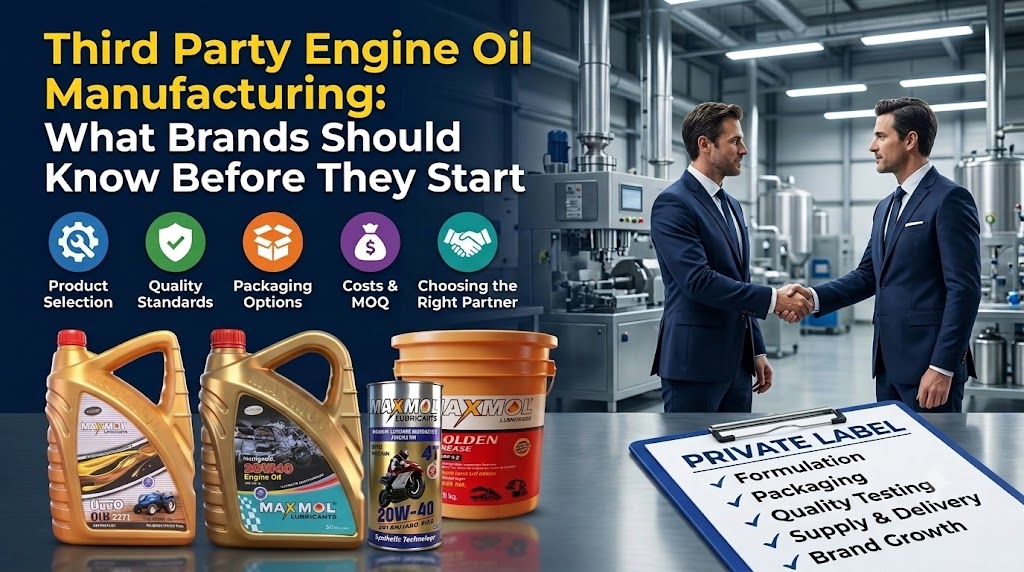
Starting your own engine oil brand can be an attractive business opportunity in India’s growing automotive and lubricant market. However, setting up a complete engine oil manufacturing plant requires significant investment in land, machinery, blending equipment, storage facilities, laboratories, raw materials, manpower and regulatory compliance.
This is where a third-party engine oil manufacturing can provide an alternative.
Through third-party manufacturing, a business can launch engine oil products under its own brand without necessarily establishing its own manufacturing facility. An experienced engine oil manufacturer in India produces the lubricant according to agreed product specifications, while the brand owner focuses on branding, marketing, sales and distribution.
However, choosing a third-party manufacturer is an important business decision. Product quality, formulation, packaging, minimum order quantity, pricing, documentation and supply reliability can all affect the success of your brand.
In this guide, we explain third party engine oil manufacturing, how the process works, what brands should check before starting and how to choose a suitable manufacturing partner.
What Is Third Party Engine Oil Manufacturing?
Third party engine oil manufacturing is a business arrangement where one company manufactures engine oil products for another company or brand.
The brand owner sells the finished product under its own brand name, while the manufacturing partner handles the agreed manufacturing activities.
For example, suppose you want to launch your own motorcycle engine oil brand. Instead of building your own lubricant manufacturing plant, you can work with a third party engine oil manufacturer that has suitable production and quality-control facilities.
The manufacturer can produce the required engine oil according to the agreed specifications and packaging requirements.
The brand owner can then focus on:
- Brand development
- Product positioning
- Marketing
- Dealer development
- Distributor networks
- Retail sales
- Workshop relationships
- Customer service
This model is also commonly associated with private label engine oil manufacturing.
Why Are Brands Choosing Third Party Engine Oil Manufacturing?
The lubricant business requires more than simply buying base oil and adding additives. A commercial manufacturing operation needs appropriate infrastructure, production systems, quality-control processes, storage arrangements and technical expertise.
For a new business, building this infrastructure from the beginning can require considerable capital.
With third party engine oil manufacturing, businesses can outsource production and allocate more resources toward market development.
Some of the potential advantages include:
1. Lower Manufacturing Infrastructure Investment
Building a manufacturing facility requires investment in production equipment, storage tanks, laboratories, utilities, safety systems and other infrastructure.
Third-party manufacturing allows a brand to use an established manufacturer’s facilities instead of building all manufacturing infrastructure itself.
2. Faster Brand Development
A business can concentrate on creating its brand identity, packaging and distribution network while the manufacturing partner manages production.
The actual launch timeline depends on formulation selection, packaging development, order quantities, testing and production schedules.
3. Access to Manufacturing Expertise
An experienced lubricant manufacturer may have knowledge of different lubricant formulations, raw materials, blending processes, testing procedures and packaging requirements.
This can be useful for businesses entering the lubricant market for the first time.
4. Focus on Sales and Distribution
Instead of managing every part of production, the brand can focus on selling its products through:
- Automotive dealers
- Spare parts shops
- Engine oil dealers
- Workshops
- Service centres
- Distributors
- Retailers
- Online channels
- Bulk buyers
Who Can Start an Own Engine Oil Brand?
Third-party manufacturing is not limited to large companies.
Depending on the manufacturer’s requirements and applicable regulations, the model may be suitable for:
- Automotive spare parts dealers
- Lubricant distributors
- Engine oil wholesalers
- Automobile accessory businesses
- Workshop owners
- Entrepreneurs
- Startups
- Existing lubricant brands
- Regional distributors
- Companies expanding into automotive products
For example, an established automotive spare parts distributor may decide to introduce its own motorcycle engine oil brand to its existing dealer network.
Similarly, a lubricant distributor may want to develop a private-label product range instead of selling only other companies’ brands.
How Does Third Party Engine Oil Manufacturing Work?
The process can vary from one manufacturer to another, but a typical third party engine oil manufacturing process can involve the following stages.
Step 1: Understand Your Target Market
Before selecting an engine oil manufacturer, first determine who you want to sell to.
Your target market could include:
- Motorcycle owners
- Car owners
- Commercial vehicle operators
- Transport companies
- Tractor owners
- Agricultural users
- Automobile workshops
- Industrial businesses
Your target market will influence your product range, packaging, pricing and distribution strategy.
For example, if your primary customers are motorcycle workshops and spare parts dealers, your initial product range may focus on motorcycle engine oils rather than launching a large range of industrial lubricants.
Step 2: Decide Which Products You Want to Launch
The next step is to identify the products required for your brand.
Depending on your market and manufacturing partner, your range may include:
- Bike engine oil
- Motorcycle engine oil
- 4T engine oil
- Car engine oil
- Diesel engine oil
- Commercial vehicle engine oil
- Tractor engine oil
- Gear oil
- Hydraulic oil
- Coolant
- Industrial lubricants
- Grease
For engine oils, viscosity grades such as 10W-30, 10W-40, 15W-40, 20W-40 and 20W-50 may be relevant to different applications.
However, the correct product should always be selected according to the intended vehicle or equipment application and applicable manufacturer and industry specifications.
Step 3: Discuss Formulation Requirements
One of the most important parts of third party engine oil manufacturing is selecting the appropriate formulation.
Engine oil performance depends on several factors, including:
- Base oil
- Additive system
- Viscosity
- Performance requirements
- Manufacturing process
- Quality control
A manufacturer should be able to explain the available product options and their intended applications.
Do not select a formulation simply because another brand is selling it successfully.
Your product should be developed or selected according to the requirements of your target application and the claims you intend to make.
Step 4: Select Your Packaging
Packaging plays an important role in lubricant branding.
Depending on the product, market and manufacturer, engine oil may be available in different pack sizes.
Common packaging options can include:
- 900 ml
- 1 litre
- 3 litre
- 3.5 litre
- 5 litre
- 7.5 litre
- 10 litre
- 20 litre
- 50 litre
- 210 litre
The exact sizes available will depend on the manufacturer’s packaging capabilities and your target market.
You should consider:
- Bottle design
- Label design
- Cap
- Seal
- Product colour
- Carton
- Batch information
- Manufacturing information
- MRP and other required declarations
All packaging should comply with applicable labelling and legal requirements.
Step 5: Build Your Brand Identity
Third-party manufacturing produces the product, but your brand is what customers see in the market.
Before production begins, develop a clear brand identity.
This may include:
- Brand name
- Logo
- Colour scheme
- Product names
- Packaging design
- Brand messaging
- Website
- Marketing material
If you intend to build a long-term lubricant business, consider protecting your brand through appropriate intellectual property measures such as trademark registration.
Conduct the necessary trademark search and obtain professional advice regarding registration.
Step 6: Determine Minimum Order Quantity
One of the first questions a new brand should ask a third party engine oil manufacturer is:
What is the minimum order quantity?
MOQ can vary depending on:
- Product formulation
- Pack size
- Packaging material
- Label printing
- Production batch
- Raw material requirements
- Customization
A new business should avoid placing an unnecessarily large first order simply to obtain a lower per-unit manufacturing price.
Large inventory can tie up working capital and create storage and inventory-management challenges.
Step 7: Calculate the Complete Product Cost
Do not calculate your product cost only on the basis of the manufacturing price.
Your actual landed cost may include:
- Engine oil manufacturing cost
- Base oil and additive costs, where applicable
- Bottle
- Cap
- Label
- Carton
- Packaging
- Testing
- Transportation
- Warehousing
- Taxes
- Marketing
- Distributor margin
- Retailer margin
Understanding the complete cost structure will help you establish a realistic selling price and distribution margin.
Quality Control in Third Party Engine Oil Manufacturing
Quality should be one of the most important considerations when selecting a manufacturing partner.
Engine oil is a technical product. Inconsistent formulation or manufacturing quality can affect product performance and customer confidence.
Before entering into an agreement, ask the manufacturer about its quality-control system.
Depending on the product, relevant testing can include parameters such as:
- Kinematic viscosity
- Viscosity index
- Flash point
- Pour point
- Density
- Total base number, where applicable
- Other relevant physical and performance characteristics
You should also ask whether batch records and test reports are maintained.
For important products or large orders, independent laboratory testing may also be considered.
Why Product Consistency Matters
Imagine a customer purchases your engine oil and receives a product with different characteristics in a later batch.
Even if the packaging looks identical, inconsistent product quality can damage customer confidence.
Therefore, your manufacturing agreement should clearly define:
- Product specifications
- Approved formulation
- Quality parameters
- Testing requirements
- Batch documentation
- Packaging specifications
- Product acceptance criteria
This becomes particularly important as your sales volume grows.
How to Choose a Third Party Engine Oil Manufacturer in India
Choosing the right manufacturing partner is one of the most important decisions for a new lubricant brand.
Do not choose a manufacturer only because it offers the lowest quotation.
Consider the following factors.
Manufacturing Experience
Look for a manufacturer with relevant experience in the lubricant products you intend to sell.
Ask about its experience with:
- Motorcycle engine oil
- Car engine oil
- Commercial vehicle lubricants
- Gear oils
- Hydraulic oils
- Grease
- Industrial lubricants
Manufacturing Infrastructure
Understand the manufacturer’s production capabilities.
Where possible, evaluate:
- Blending facilities
- Storage facilities
- Packaging lines
- Laboratory facilities
- Quality-control systems
- Production capacity
A facility visit can help you understand the manufacturing environment before entering into a long-term relationship.
Product Testing
Ask how incoming raw materials, in-process products and finished lubricants are tested.
Also ask whether product test reports are available for each production batch.
Production Capacity
Your manufacturer should be able to support your expected order volumes.
A manufacturer suitable for a small startup order may not necessarily have the capacity required when your business expands.
Discuss both current requirements and expected future demand.
Packaging Capabilities
Check whether the manufacturer can supply your preferred bottle sizes, labels and cartons.
If you want custom packaging, confirm:
- Minimum quantity
- Printing requirements
- Development charges
- Lead time
- Packaging storage requirements
Delivery Timelines
A good product is of limited commercial value if it cannot be supplied on time.
Discuss production and dispatch timelines before placing an order.
Your agreement should clearly explain expected delivery arrangements and responsibilities.
Legal and Regulatory Considerations
Before launching your engine oil brand, understand the legal and regulatory requirements applicable to your business and products in India.
Depending on your business structure and product category, considerations may include:
- Business registration
- GST registration, where applicable
- Trademark protection
- Legal Metrology requirements
- Product-specific standards or certifications
- Packaging and labelling requirements
- Plastic packaging and applicable EPR obligations
- Environmental requirements
- Applicable manufacturing permissions
The exact requirements can vary depending on the product, packaging, manufacturer and business arrangement.
Therefore, do not assume that the manufacturer’s registrations automatically satisfy every requirement applicable to your brand.
It is advisable to verify current requirements with the relevant government authorities or a qualified compliance professional.
What Should Be Included in a Manufacturing Agreement?
A written agreement can help both parties understand their responsibilities.
A third-party manufacturing agreement may address:
- Product specifications
- Formulation
- Raw materials
- Quality standards
- Packaging
- MOQ
- Pricing
- Payment terms
- Production timelines
- Delivery
- Product testing
- Rejected batches
- Product complaints
- Confidentiality
- Intellectual property
- Brand ownership
- Liability
- Termination conditions
The agreement should clearly establish who is responsible for each stage of the process.
Common Mistakes Brands Make
1. Choosing the Cheapest Manufacturer
The cheapest quotation is not necessarily the lowest total business cost.
A low price may come with differences in formulation, packaging, testing, service or delivery.
Compare manufacturers on equivalent specifications.
2. Starting With Too Many Products
Launching 20 or 30 products at once can create inventory and marketing challenges.
A focused product range can make it easier to understand customer demand.
3. Ignoring Packaging Quality
Packaging is the first physical interaction many customers have with your brand.
Poor-quality bottles, labels or cartons can negatively affect the perceived value of the product.
4. Making Unsupported Claims
Avoid claims such as:
- “Best engine oil”
- “Guaranteed fuel saving”
- “Doubles engine life”
- “Longest drain interval”
unless such claims can be appropriately supported and are legally permissible.
Technical marketing claims should be accurate and evidence-based.
5. Not Checking Product Samples
Before placing a large order, review samples and relevant technical documentation.
Where appropriate, independent testing can provide additional verification.
6. Ignoring Distribution
Manufacturing the product is only one part of the business.
You also need a plan for getting the product into the hands of customers.
This may involve:
- Dealers
- Distributors
- Workshops
- Retailers
- Spare parts shops
- Online channels
- Direct sales
How Much Does Third Party Engine Oil Manufacturing Cost?
There is no single fixed price for third party engine oil manufacturing.
The final cost depends on several variables.
These can include:
- Engine oil formulation
- Base oil
- Additive package
- Viscosity grade
- Packaging size
- Bottle quality
- Label design
- Order quantity
- Testing
- Transportation
- Taxes
- Customization requirements
For this reason, a manufacturer should provide a quotation based on your specific requirements.
When comparing quotations, make sure you compare products with the same specifications and packaging.
Is Third Party Engine Oil Manufacturing Profitable?
Third-party manufacturing can reduce the infrastructure investment required to enter the lubricant market, but profitability is not automatic.
Your business model needs to account for:
Manufacturing Cost + Packaging + Logistics + Marketing + Distribution Margin + Other Business Costs = Total Cost
Your selling price and expected sales volume must then be evaluated against the total cost.
Market demand, competition, dealer margins, brand positioning and repeat purchases can all influence profitability.
Before starting, prepare a basic financial model covering:
- Initial investment
- First production order
- Monthly operating expenses
- Selling price
- Dealer margin
- Distributor margin
- Expected sales volume
- Working capital
- Break-even point
How to Build Your Own Engine Oil Brand
Once your manufacturing partner has been selected, the next challenge is building market demand.
Build a Professional Brand
Your packaging, website, social media presence and sales materials should communicate a consistent brand identity.
Develop Dealer Relationships
Automotive dealers and spare parts retailers can be important channels for lubricant brands.
Provide them with:
- Product information
- Pricing
- Dealer margins
- Marketing material
- Product training
- Customer support
Work With Workshops
Automobile workshops can influence which lubricant products customers purchase.
Develop relationships with relevant workshops and provide accurate technical product information.
Invest in Digital Marketing
A professional website can help customers and potential distributors find your products online.
Useful content can include:
- Engine oil guides
- Viscosity explanations
- Vehicle maintenance articles
- Product information
- Lubricant FAQs
- Dealer information
- Distributor opportunities
Search engine optimization can help your website reach people searching for engine oil and lubricant-related information.
Third Party Engine Oil Manufacturing vs. Setting Up Your Own Plant
Both models have different requirements.
| Factor | Third-Party Manufacturing | Own Manufacturing Plant |
| Initial infrastructure | Lower | Higher |
| Manufacturing control | Contract-based | Direct |
| Production investment | Lower | Higher |
| Technical responsibility | Shared/contract-based | Direct |
| Brand control | High | High |
| Manufacturing responsibility | Outsourced | In-house |
| Production flexibility | Depends on partner | Depends on own capacity |
| Focus | Brand and distribution | Manufacturing + brand |
The appropriate model depends on your capital, technical capabilities, expected production volume and long-term business objectives.
Questions to Ask a Third Party Engine Oil Manufacturer
Before finalizing your manufacturing partner, ask:
- What engine oil products do you manufacture?
- What is your minimum order quantity?
- What viscosity grades are available?
- Can you manufacture under my brand name?
- Can you provide customized packaging?
- What quality tests are performed?
- Can I receive product test reports?
- What is the production lead time?
- What are the payment terms?
- What packaging sizes are available?
- Can you support increasing order volumes?
- What documentation will be provided?
- What happens if a batch does not meet the agreed specifications?
- Who is responsible for packaging and labelling compliance?
- What are the transportation and delivery arrangements?
Getting clear answers to these questions can help you compare potential manufacturing partners more effectively.
Conclusion
Third party engine oil manufacturing can provide an efficient way for entrepreneurs, distributors, retailers and established businesses to enter the lubricant market without investing immediately in their own manufacturing infrastructure.
However, the success of an engine oil brand depends on much more than simply finding a manufacturer. Product quality, formulation, packaging, compliance, pricing, supply consistency, distribution and marketing all play important roles.
Before starting, take time to evaluate your target market, calculate your complete costs and compare potential manufacturing partners carefully.
A reliable third party engine oil manufacturer in India should be able to clearly communicate its manufacturing capabilities, product specifications, quality-control processes, MOQ, packaging options and delivery arrangements.
For businesses planning to launch their own engine oil or lubricant brand, working with an experienced manufacturing partner can provide a foundation for developing products while allowing the brand owner to concentrate on sales, distribution and long-term market growth.