
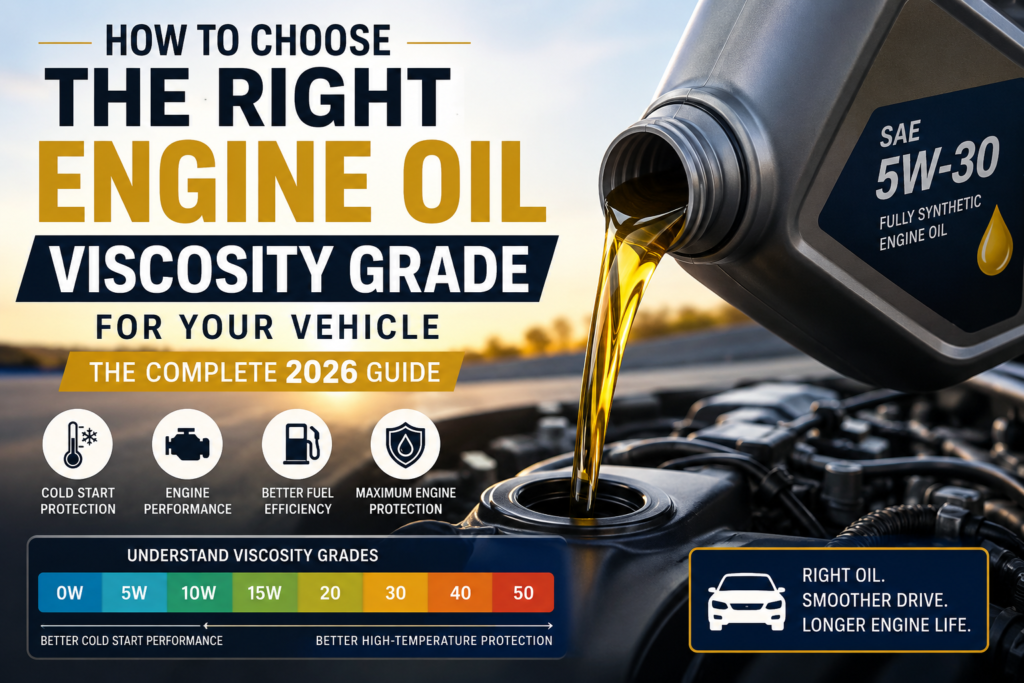
Choosing the right engine oil viscosity grade is one of the simplest things you can do for your vehicle — and one of the most misunderstood. Pour in the wrong grade, and you could be looking at poor cold starts, reduced fuel economy, increased engine wear, or in worst cases, long-term engine damage. Pour in the right one, and your engine runs smoother, lasts longer, and performs the way the manufacturer intended.
In this guide, we’ll break down exactly what viscosity means, how to read the numbers on every oil bottle, which grade suits which vehicle, how climate and driving habits change the equation, and the biggest trends reshaping engine oil in 2026 — including the industry-wide shift toward ultra-low-viscosity synthetics.
Table of Contents
- What Is Engine Oil Viscosity?
- Why Viscosity Matters So Much
- Decoding the Numbers: What “5W-30” Really Means
- Single-Grade vs. Multi-Grade Oils
- Common Viscosity Grades and Their Best Uses
- The 2026 Shift Toward Ultra-Low-Viscosity Oils
- How Climate Affects Your Viscosity Choice
- How Engine Age and Mileage Affect Your Choice
- How Driving Style Affects Your Choice
- Synthetic vs. Conventional vs. Synthetic Blend
- Beyond Viscosity: API, ACEA, and HTHS Explained
- Step-by-Step: How to Choose the Right Oil for Your Vehicle
- Common Myths About Engine Oil Viscosity
- What Happens If You Use the Wrong Viscosity
- Frequently Asked Questions
- Final Takeaway
Viscosity is a measurement of a fluid’s resistance to flow. Think of the difference between honey and water: honey is thick and pours slowly (high viscosity), while water is thin and flows quickly (low viscosity). Bike Engine oil behaves the same way, except its thickness changes dramatically depending on temperature.
When your engine is cold, oil naturally thickens. When it heats up during operation, it thins out. Bike Engine oil viscosity grades are designed to describe how an oil performs across this temperature range — both when your engine is freezing cold at start-up and when it’s running hot on the highway.
Modern engines are precision-built machines with incredibly tight tolerances between moving parts. The oil’s job is to maintain a consistent, protective film between these parts under wildly different conditions — from a sub-zero morning start to a summer highway drive. Choosing the right viscosity ensures that film is neither too thick (causing drag and poor cold flow) nor too thin (causing metal-on-metal contact and excessive wear).
It’s easy to think of oil viscosity as a minor technical detail, but it has an outsized impact on several things that matter to every driver:
- Cold-start protection. A significant portion of engine wear happens in the first few seconds after starting the engine, before oil has fully circulated. Thinner oils flow to critical components faster, reducing this wear window.
- Fuel efficiency. Thicker oils create more internal friction, which your engine has to work harder to overcome. This is a major reason manufacturers have shifted toward thinner oils in recent years — every bit of reduced friction improves miles per gallon.
- High-temperature protection. Under heavy load, high RPM, or hot climates, oil needs to remain thick enough to keep a protective film between metal surfaces. Too thin, and you risk metal-on-metal contact.
- Engine longevity. Using the correct viscosity consistently, combined with regular oil changes, is one of the single biggest factors in how long an engine lasts.
- Warranty compliance. Using a viscosity outside of what your manufacturer specifies can, in some cases, affect warranty coverage if it contributes to a mechanical failure.
Open the hood of almost any modern car and you’ll find a viscosity grade like 5W-30, 0W-20, or 10W-40 stamped somewhere near the oil cap. These numbers follow a standard set by SAE (the Society of Automotive Engineers), and once you understand the formula, you’ll never be confused by an oil bottle again.
The first number (before the “W”): Cold-weather performance
The “W” stands for Winter, not weight. The number before it tells you how the oil behaves in cold temperatures — specifically, how easily it flows and pumps at low temperatures. A lower number means the oil stays fluid even in very cold conditions:
- 0W flows extremely well even in sub-zero temperatures
- 5W flows well in cold temperatures
- 10W and 15W are thicker in the cold and take longer to circulate
The second number: High-temperature viscosity
The number after the “W” describes the oil’s thickness once the engine reaches normal operating temperature (measured around 100°C). A higher number means a thicker oil that maintains a stronger protective film under heat and pressure:
- 20 and 30 are relatively thin at operating temperature — common in modern fuel-efficient engines
- 40 and 50 are thicker, offering more protection under heavy load or high heat
So when you see 5W-30, it means: this oil flows like a “5-weight” oil when cold, and behaves like a “30-weight” oil once warmed up. It’s engineered to perform well across that entire range, rather than being ideal at just one temperature.
Single-grade oils (like SAE 30 or SAE 40) maintain roughly the same viscosity regardless of temperature. They were the industry standard decades ago and are still used today in some small engines, older classic cars, and certain industrial or agricultural equipment. Their simplicity keeps costs low, but they aren’t well suited to modern engines that experience wide temperature swings.
Multi-grade oils (like 5W-30 or 10W-40) are formulated with additives that allow them to behave differently at different temperatures — thin enough to flow well when cold, thick enough to protect when hot. Nearly every modern passenger vehicle uses a multi-grade oil because it performs reliably across seasons and climates without needing to be changed based on the weather.
| Grade | Typical Use Case |
| 0W-16 | Newest-generation hybrid and ultra-fuel-efficient engines with very tight tolerances |
| 0W-20 | Widely used in modern passenger cars and hybrids for maximum fuel economy and cold-start protection |
| 5W-20 | Many older and newer four-cylinder engines designed for fuel efficiency |
| 5W-30 | One of the most common all-purpose grades; suits a huge range of modern gasoline engines |
| 5W-40 | Popular for diesel engines and performance vehicles needing strong hot-temperature protection with good cold flow |
| 10W-30 | Older gasoline engines and increasingly, modern diesel fleets moving away from 15W-40 |
| 10W-40 | Older or higher-mileage engines in moderate climates |
| 15W-40 | Traditionally the diesel and heavy-duty standard, especially in warmer climates |
| 20W-50 | High-performance engines, motorcycles, and vehicles operating in very hot climates or under heavy load |
Keep in mind this table is a general reference — your owner’s manual always overrides general guidance, since it reflects testing specific to your exact engine.
If you’ve bought a new car recently, you may have noticed the recommended oil is thinner than what your last vehicle used. This isn’t a coincidence — it reflects one of the biggest trends in the automotive industry right now.
Passenger vehicles: More than 40% of passenger vehicle oil sales today are 5W-30 and 0W-20 grades, and automakers are increasingly factory-filling new models — especially hybrids — with 0W-20 or even 0W-16. These ultra-thin oils are designed to meet strict fuel-economy targets by minimizing internal friction from the moment the engine starts.
Heavy-duty and diesel fleets: The change is even more dramatic in the trucking and fleet world. Traditional 15W-40, once the universal diesel standard, is being phased out. Major engine manufacturers such as Detroit, Cummins, and Volvo now factory-fill with 10W-30 instead. Fleets that stick with 15W-40 out of habit are estimated to lose several hundred dollars per truck annually in fuel savings. Looking further ahead, upcoming API PC-12 heavy-duty oil specifications are expected to introduce even lower-viscosity 0W-20 and 5W-20 options for diesel engines.
Why this shift is happening:
- Tighter engine tolerances in modern designs allow — and require — thinner oils
- Stricter fuel-economy and emissions regulations push manufacturers toward friction-reducing formulations
- Advances in synthetic base oils and additive technology allow thin oils to maintain protection that used to require thicker formulations
- Turbocharged and hybrid powertrains have different lubrication demands than older naturally aspirated engines
An important caveat: thinner is not automatically better for every engine. Older engines, high-performance engines, and engines with more internal wear were often designed around thicker oil specifications, and switching to an ultra-thin oil not approved for that engine can reduce protection rather than improve it. The trend toward thinner oils applies specifically to engines engineered for it — always check your manual before following the industry trend.
Temperature is one of the biggest factors in viscosity selection, which is exactly why the “W” rating exists.
- Cold climates: If you live somewhere with harsh winters, a lower “W” number (0W or 5W) is critical. It ensures oil flows quickly to protect your engine during cold starts, when wear risk is highest. Using an oil that’s too thick for the cold can leave parts under-lubricated for the first crucial seconds after starting.
- Hot climates: In consistently hot regions, a higher second number (like 40 or 50) may be recommended to maintain a strong protective film at high operating temperatures, especially under heavy load, towing, or stop-and-go traffic in extreme heat.
- Moderate/seasonal climates: Multi-grade oils are specifically designed to handle temperature swings well, which is why most manufacturers recommend a single multi-grade oil year-round rather than switching grades seasonally.
If you live somewhere with extreme seasonal swings — very cold winters and very hot summers — check whether your manufacturer recommends different grades for each season, though most modern multi-grade oils are formulated to handle both without switching.
As engines age, internal clearances between moving parts tend to widen slightly due to normal wear. This is one reason many high-mileage oil formulations use a slightly thicker viscosity, or include seal-conditioning additives, to compensate:
- Newer engines are built to tighter tolerances and are usually designed around thinner, low-viscosity oils for efficiency.
- High-mileage engines (typically 75,000+ miles) may benefit from a high-mileage-specific oil, sometimes with a slightly higher viscosity, to reduce oil consumption and minor leaks caused by worn seals.
- Classic or older carbureted engines often call for older-style single-grade or higher-viscosity oils, since they weren’t engineered around modern synthetic-thin formulations.
If your engine has higher mileage and you’ve noticed increased oil consumption, it’s worth discussing with a mechanic whether a slightly higher viscosity or high-mileage formulation makes sense — even if it deviates slightly from the original factory spec.
Two identical vehicles can have very different oil needs depending on how they’re driven:
- Towing, hauling, or off-roading generates more heat and mechanical stress, which can justify a higher-viscosity oil or one with a higher HTHS (High-Temperature High-Shear) rating for extra protection.
- Stop-and-go city driving increases the number of cold starts and short trips, both of which are harder on oil and engine components — this is where a well-matched cold-flow (“W”) rating really matters.
- Track driving or spirited performance driving pushes engines to higher RPMs and temperatures for sustained periods, often calling for oils with higher HTHS ratings to prevent the oil film from breaking down under pressure.
- Highway commuting at steady speeds is generally the easiest driving condition on oil, and most standard manufacturer-recommended grades handle it well.
If your driving falls into a more demanding category, it’s worth checking whether your manufacturer offers a “severe service” oil change interval or viscosity recommendation, as many do.
Viscosity grade and oil type (synthetic vs. conventional) are related but separate decisions.
- Full synthetic oils are engineered from advanced base oils and precisely formulated additives. They flow instantly at startup — even in very cold conditions — offering excellent protection from the very first revolution of the engine. They also tend to resist breakdown at high temperatures better than conventional oil, making them the preferred choice for most modern engines, especially those requiring ultra-low-viscosity grades like 0W-20 or 0W-16.
- Synthetic blends combine conventional and synthetic base oils, offering some of the performance benefits of full synthetic at a lower price point — a reasonable middle ground for older engines that don’t strictly require full synthetic.
- Conventional (mineral) oils are the traditional, less-refined option. They’re generally more affordable but break down faster and don’t perform as well at extreme temperatures, which is why they’re becoming less common as the industry shifts toward synthetics.
Because ultra-low-viscosity grades rely on advanced formulation to maintain protection despite being thin, they are almost always full synthetic — you generally won’t find a conventional 0W-16 oil.
Viscosity is only one part of the equation. Even if two oils share the same SAE grade, they can differ significantly in performance based on their certifications and additive packages.
- API (American Petroleum Institute) rating: Indicates the oil meets specific performance standards for gasoline or diesel engines (e.g., API SP for gasoline engines, API FA-4 for certain diesel applications). Always check that the oil’s API category matches what your engine requires.
- ACEA (European vehicle manufacturers’ association) rating: Common on European vehicles, categorizing oils by performance for gasoline engines (A), diesel engines (B), and low-emission/catalyst-compatible engines (C). For example, ACEA C3 oils are designed for engines requiring higher HTHS protection despite being part of the low-emission category.
- HTHS (High-Temperature High-Shear) viscosity: This measures how well oil resists thinning out under the intense pressure found in an engine’s main bearings during operation. High HTHS oils (3.5 mPa·s or higher) are typically required for high-performance engines and older heavy-duty applications, while low HTHS oils (2.9 mPa·s or lower) are designed for modern fuel-efficient engines built around 0W-20 or 0W-16 specifications.
When shopping for oil, don’t just match the viscosity number on the bottle — confirm it also carries the correct API and/or ACEA certification for your specific engine.
- Start with your owner’s manual. This is the single most reliable source of truth, since it reflects testing specific to your exact engine, not general guidance.
- Check the oil cap or dipstick. Many manufacturers stamp the recommended viscosity directly on or near the oil cap as a quick reference.
- Factor in your climate. Choose a lower “W” number for cold winters, and consider a higher second number if you’re in a consistently hot climate.
- Consider your engine’s age and mileage. High-mileage engines may benefit from high-mileage-specific formulations.
- Think about how you drive. Towing, off-roading, or performance driving may justify a higher-viscosity or higher-HTHS oil, if approved for your engine.
- Match API and ACEA certifications, not just the SAE number. Two oils with the same viscosity can differ in additive quality and protection — confirm the oil meets your engine’s specific service category.
- Choose full synthetic where possible, especially for modern engines requiring low-viscosity, low-HTHS oils.
- When unsure, consult a professional. A mechanic can factor in engine condition, mileage, and driving habits that a general chart can’t capture — and many oil brands offer online “oil finder” tools where you enter your exact make, model, and year.
- Stick with regular oil change intervals. Even the perfect viscosity won’t protect your engine if the oil itself is old, contaminated, or broken down.
Myth: Thicker oil always means better protection.
Not true. Using an oil thicker than what your engine is designed for can actually increase wear, particularly during cold starts, since it flows more slowly to critical components. Manufacturers spend significant engineering time calibrating the exact viscosity their engine needs — going thicker “for extra protection” often does more harm than good.
Myth: You can switch to any viscosity as long as it’s close to the recommended one.
Modern engines, especially those with variable valve timing systems that rely on oil pressure, can be sensitive to viscosity changes. Even a seemingly small deviation can affect how these systems perform.
Myth: Synthetic oil doesn’t need to be changed as often.
While synthetic oils generally last longer than conventional oils and often support extended change intervals, “longer” doesn’t mean “indefinite.” Always follow your manufacturer’s recommended interval for your specific oil type and driving conditions.
Myth: All 5W-30 oils are the same.
Viscosity grade is just one specification. Two 5W-30 oils can have very different API/ACEA certifications, additive packages, and quality levels. The viscosity number tells you about flow characteristics, not overall oil quality.
Myth: Older engines should always use thicker oil.
While high-mileage formulations do sometimes use a slightly thicker viscosity to help with worn seals, this isn’t a blanket rule — some older engines still perform best with the exact viscosity specified when they were new. Mileage-related adjustments should be based on actual symptoms like oil consumption, not just the age of the car.
Using an incorrect viscosity grade — even briefly — can cause a range of issues:
- Too thick for the engine or climate: Slower oil flow during cold starts, increased internal friction, reduced fuel economy, and added strain on the oil pump.
- Too thin for the engine or driving conditions: Reduced protective film under heat and load, increased risk of metal-on-metal contact, and potential for accelerated engine wear, especially during towing, high RPM driving, or hot climates.
- Mismatched HTHS rating: In high-performance or heavy-duty applications, using an oil with too low an HTHS rating can lead to the oil film breaking down under extreme pressure, risking bearing damage over time.
- Warranty implications: If a mechanical failure is linked to using an unapproved oil viscosity, it can complicate warranty claims.
If you’ve accidentally used the wrong viscosity for a single oil change, it’s rarely catastrophic — but you should switch back to the manufacturer-recommended grade at your next change and monitor for any unusual noises, oil consumption, or performance changes in the meantime.
Your owner’s manual is always the definitive source for the correct Bike engine oil viscosity — no chart or guide should override it. But understanding what those numbers actually represent empowers you to make smarter decisions, especially as the industry continues shifting toward thinner, more fuel-efficient synthetic oils across both passenger and heavy-duty vehicles.
Getting viscosity right isn’t just a technicality — it’s one of the most cost-effective things you can do to protect your engine, improve fuel economy, and extend your vehicle’s lifespan. When in doubt, check your manual, consider your climate and driving habits, and don’t hesitate to consult a trusted mechanic for guidance specific to your vehicle.