
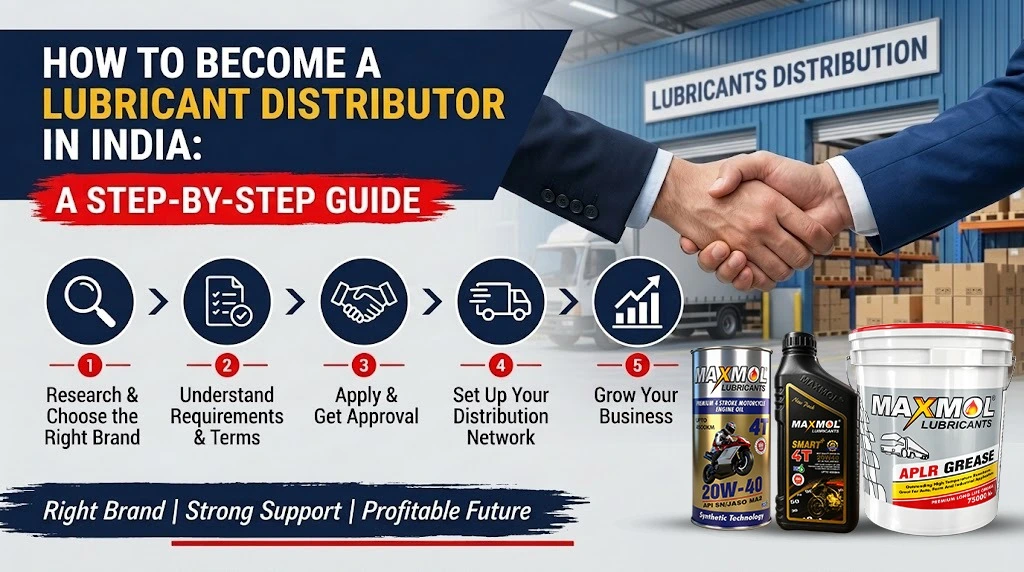
HOW TO BECOME A LUBRICANT DISTRIBUTOR IN INDIA: A STEP-BY-STEP GUIDE
If you are wondering how to become a lubricant distributor in India, you are looking at one of the country’s most stable trading businesses. Cars, trucks, tractors, factory machines and power equipment all need engine oils, gear oils, hydraulic oils and greases on a regular schedule, so demand keeps coming back. This guide walks you through the whole lubricant distributorship process, from market research and registrations to signing with a brand and scaling up. WHY START A LUBRICANT DISTRIBUTION BUSINESS IN INDIA? – Repeat demand: Oil changes and top-ups happen on fixed schedules, so customers reorder often. – Many types of buyers: Garages, fuel stations, spare-parts shops, transporters, farms and factories all buy lubricants. – Room to grow: You can start with one district and one brand, then add territories, products and sub-dealers. – Brand support: Established companies often provide training, marketing material and sales schemes. There are real challenges too: money locked in stock, credit given to customers, and tough competition from big brands and unorganised players. Plan for these from day one UNDERSTAND THE LUBRICANT MARKET IN INDIA Before investing, learn how the market works. Main segments: 1. Automotive lubricants: Engine oils for two-wheelers, cars and commercial vehicles, plus gear oils, transmission fluids, brake fluids and coolants. This is the largest segment. 2. Industrial lubricants: Hydraulic, compressor and turbine oils, metalworking fluids and greases for factories and heavy machinery. 3. Marine and specialty lubricants: A niche segment with higher technical demands. Major players: – PSU brands: IndianOil (Servo), BPCL (Mak), HPCL (HP Lubricants) Become a Distributor – Private and multinational brands: Castrol, Shell, Gulf, Valvoline, Motul, Veedol and others – Regional blenders: Smaller companies serving particular states or industries Action: Visit garages, fuel stations and spare-parts shops near you. Note which brands are sold, their price points and which are missing. Those gaps are your opportunity. CHOOSE YOUR SEGMENT AND TERRITORY You cannot serve everyone at the start. Decide who you will sell to based on your contacts and local demand. Ask yourself: – Do I know garage owners, transporters or factory managers in my region? – Is my area strong in commercial vehicles, agriculture, two-wheelers or manufacturing? – Do I want to focus on retail outlets or on industrial (B2B) customers? A distributor in an industrial belt such as Pune or Ludhiana will focus differently from one in a farming district where tractor and pump oils dominate. PICK YOUR BUSINESS MODEL 1. Authorised distributor of an established brand You get a defined territory, brand support and a set pricing structure. Best for: Beginners who want credibility. 2. Distributor of a regional or emerging brand Easier entry and often higher margins, but weaker brand pull. Best for: People with strong local networks. 3. Private-label trading A third-party blender makes oil under your own brand. Best for: Experienced entrepreneurs with capital and a marketing plan. Most first-timers do best as an authorised distributor of a known or fast-growing brand. COMPLETE REGISTRATIONS, LICENSES AND DOCUMENTS Here are the documents typically required for a lubricant distributorship: 1. Business structure: Proprietorship, partnership, LLP or private limited company. A proprietorship is the fastest to set up, while a company or LLP builds more trust with brands and banks. 2. PAN of the business or proprietor. 3. GST registration: Required for trading. Lubricating oils are generally taxed at 18% GST, but confirm the current rate and HSN code with a chartered accountant. 4. Udyam (MSME) registration: Optional, but helpful for loans and scheme benefits. 5. Shop and Establishment or trade license from your local authority. 6. Current bank account in the business name. 7. Warehouse approvals: Check local fire-safety and municipal rules for storage. They vary by state and quantity stored. 8. Legal Metrology awareness: Packaged goods must follow labelling and declaration rules. Brands handle this for their own packs, but it matters if you sell under your own label. Requirements differ by state, so consult a local CA or company secretary before filing. PLAN YOUR LUBRICANT DISTRIBUTORSHIP INVESTMENT Investment depends on the brand, territory and scale. Budget for: – Opening stock (working capital): The largest cost. Many brands require a minimum first order or a security deposit. – Warehouse or godown: Rent or purchase, plus racks and pallets. – Delivery vehicle: A small pickup or commercial vehicle. – Staff: A salesperson, warehouse helper and possibly an accountant. – Software, signage and marketing. – Buffer capital: To cover customer credit and delayed payments. Small distributorships often start with a few lakh to tens of lakhs of rupees, while large territorial appointments with major brands can need much more. Always ask each brand for its exact requirements instead of relying on general figures. HOW TO GET A LUBRICANT DISTRIBUTORSHIP FROM A BRAND This is the most important step. Follow this process: 1. Shortlist 5 to 10 brands that suit your territory and customers. 2. Check their websites for a “Become a Distributor” or “Business Enquiry” page. 3. Attend trade shows on automotive, lubricants and industrial supply to meet company representatives. 4. Contact regional sales managers by email or LinkedIn. 5. Submit a strong proposal that includes: – Your background and experience – Proposed territory and target segments – Existing customer network – Warehouse, vehicle and staff details – Financial capacity and bank references – A 12-month sales plan with volume targets Brands choose distributors who show market knowledge, financial stability and growth potential. WARNING: Be careful with anyone demanding a large “registration fee” or “franchise fee” upfront without a clear written agreement. Verify the company, visit its office or plant if you can, and read the contract before paying. NEGOTIATE AND SIGN THE DISTRIBUTOR AGREEMENT Have a lawyer review the agreement. Check these points: – Territory exclusivity: Is your area exclusive or shared? – Margins and pricing: Your margin, price lists and how price changes are communicated – Minimum purchase or volume targets and penalties for missing them – Credit terms and security deposit – Returns, replacements and damaged-goods policy – Schemes, incentives and
HOW TO BECOME A LUBRICANT DISTRIBUTOR IN INDIA: A STEP-BY-STEP GUIDE Read More »